

- ✓The useful question is not whether AI can complete a task. It is who is the least expensive qualified person or system to do it correctly.
- ✓Realtors should stay close to relationships, negotiation, presentations, hard decisions, personal follow-up, and content that depends on their experience and voice.
- ✓Transaction coordinators should run documented paperwork, dates, scheduling, and contract-to-close processes while the Realtor keeps the client conversations that need judgment.
- ✓Virtual assistants work best with repeatable human execution and clear SOPs. AI agents fit repetitive digital research, monitoring, information gathering, and preparation before a human decision.
- ✓A normal AI thread often handles writing, thinking, analysis, tracking, and quick problem-solving more simply than an expensive automation project.
Last week I wrote about spending $329 in four days testing an AI agent. I started that experiment because I wanted to understand what these agents really cost and where they make more sense than a virtual assistant. What came out of it was a much bigger question.
Everybody is chasing the shiny AI tool right now. Realtors are trying to automate anything they can get their hands on because, for the first time, a lot of these tools actually work. But I think “Can AI do this?” is the wrong question. The better question is: who should be doing this in the first place?
Once I started looking at the business that way, I began seeing the waste everywhere. You have expensive talent doing cheap work. You have inexpensive labor being asked to make decisions requiring experience and judgment. Then you have AI agents burning through credits doing jobs that never required an agent in the first place. You might have a Realtor spending two hours gathering information for comps while a VA is being asked to call people and build relationships. Meanwhile, an AI agent is running some complicated workflow that costs more than the task was worth.
That does not only cost money. It costs time, relationships, opportunities, and sometimes deals you never realize you lost. After years of working with virtual assistants, building SOPs, running mortgage operations, testing AI agents, and using normal AI threads every day, I have started running almost every task through the same filter:
- What does this task cost?
- How much time does it take?
- Does it require judgment or emotion?
- How often does it repeat?
- Who is the least expensive qualified person or system to do it correctly?
Simple questions. Much harder answers.
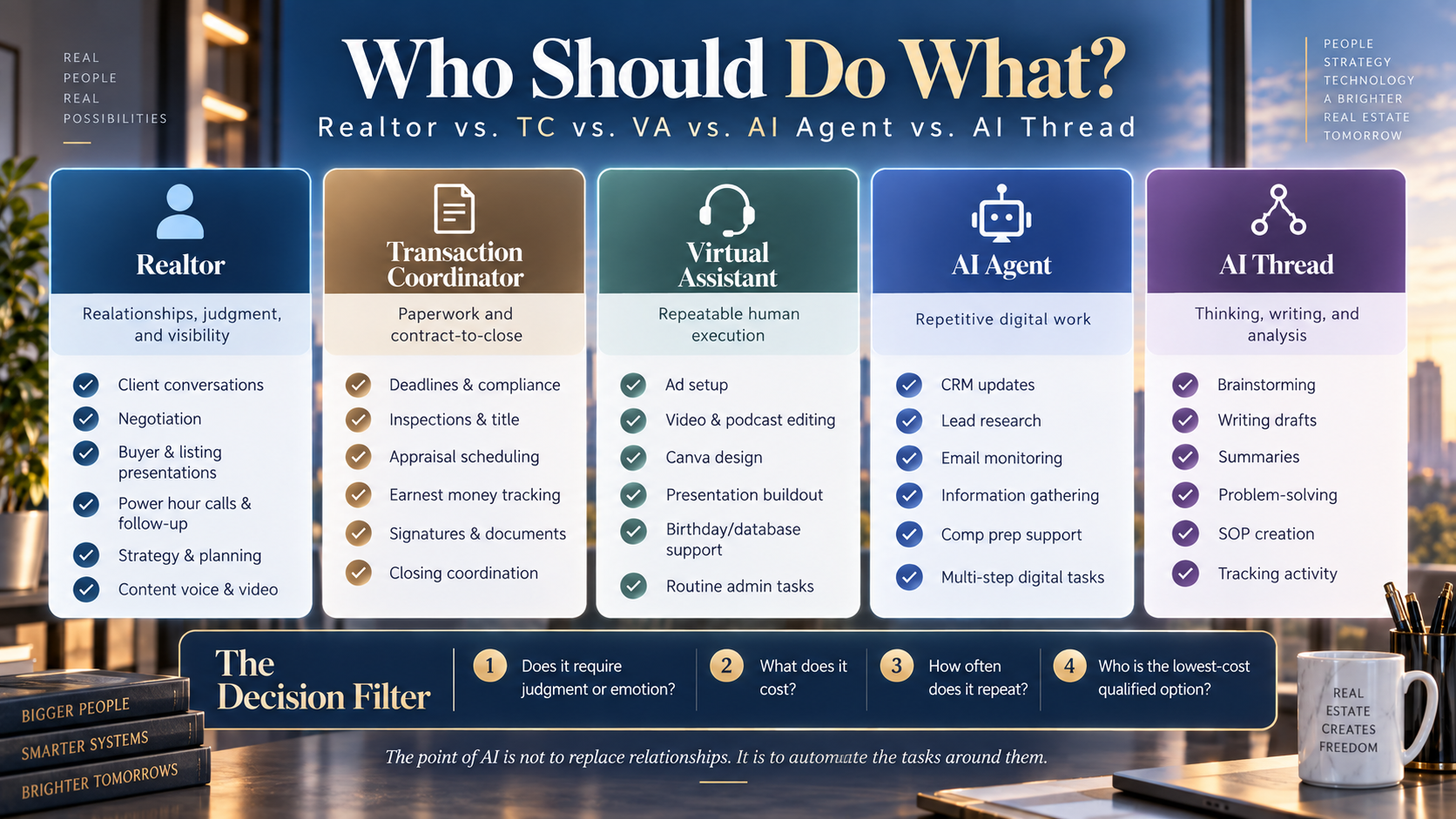
Who should do what in a modern real estate business: Realtor, transaction coordinator, virtual assistant, AI agent, or AI thread
The Work Only the Realtor Should Own
There are parts of this business I would never hand off. Talking to an actual client is at the top of the list. Negotiation stays with the Realtor. Buyer presentations stay with the Realtor. Listing presentations stay with the Realtor. If an inspection uncovers something major, the Realtor needs to be involved. Financing issues, low appraisals, difficult decisions, bad news, and anything involving emotion belong with the Realtor because the client hired you for judgment.
I have watched transactions suffer because the Realtor handed too much communication to a Transaction Coordinator. In one case, the Realtor basically disappeared and left the TC running almost everything. The TC suddenly became responsible for conversations requiring judgment, sales skill, and emotional awareness, and the transaction started falling apart. That was not a bad TC. That was a TC being asked to do the Realtor’s job.
There is another piece I would keep firmly with the Realtor, and that is relationship building. I call it the power hour. Pick up the phone. Call your sphere. Call past clients. Call people you have worked with. Send personal texts. Check in with people without needing anything from them.
We have tried delegating pieces of this. We trained VAs. We experimented with automated calling. I tested AI agents calling people directly. I even tried using AI calls with people working through credit problems. It was terrible. People did not want to talk to an AI. The conversation felt wrong, and the human connection disappeared.
I was on a call recently where a Realtor said the biggest return she still gets anywhere in her business comes from her call hour. I believe her. You might dial 30 people and reach three, but you still had three real conversations and left 27 personal voicemails. You also created reasons to send personal texts and reconnect with people who already know you.
That is hard to replace. AI should support the relationship. It should never own it.
The Same Rule Applies to Content
I also think Realtors need to stay involved in their own content, especially video. You do not need a studio, three hours to make one Reel, or a production crew every time you have something useful to say. Pull your phone out and record.
A Realtor could spend an hour recording raw material such as:
- 20 hooks based on questions clients keep asking.
- Five stories from transactions they have worked through.
- Five explanations of common buyer or seller problems.
- Several calls to action.
- A handful of quick opinions about what they are seeing in the market.
Then hand the raw footage off. The Realtor brings the experience, opinion, voice, face, and stories. Someone else handles the editing.
Working inside an existing transaction feels productive because there is always another email, another document, another update, or another small fire waiting for you. You can stay busy all day doing those things and feel like you worked hard.
Then five o’clock hits and you realize you did not call anybody. You did not talk to your database. You did not record anything. You did not follow up with a future buyer or seller. You spent the entire day servicing yesterday’s business instead of creating tomorrow’s.
Administrative work becomes a convenient place to hide from the harder work, and the harder work is usually the work only you should be doing. Every hour you spend on something someone else should have handled is an hour you did not spend talking to your sphere, meeting with a client, preparing for a listing presentation, solving a problem, or creating something that sounds like you.
That is the real cost.
Where the Transaction Coordinator Fits
My view of the Transaction Coordinator role is pretty simple. If the work involves transaction documents, dates, scheduling, or information and does not require sales judgment, it should usually sit with the TC.
That includes things like:
- Inspections.
- Title.
- Appraisal scheduling.
- Earnest money.
- Deadlines.
- Signatures.
- Closing coordination.
- Documents moving between the parties.
The TC should take as much of that work off the Realtor as possible, but the key is structure. I would never hire a TC and simply say, “Handle my transactions.” I would build SOPs around everything.
I did this on the mortgage side with a processor. I went through the different tasks the processor handled and documented them one at a time. When I eventually brought those systems into a processing company, they told me they had never had anyone show up with that level of SOP documentation.
That is exactly how I would build the TC role. You create the process, they run the process, and then you clearly define where the Realtor steps back in.
An appraisal is a perfect example. The TC can receive it, make sure it is uploaded, update the transaction system, and trigger whatever happens next. But if the appraisal comes in at value, I want the Realtor delivering that good news. Why would you give away a good client conversation? If the appraisal comes in low, the Realtor absolutely handles the call.
The paperwork belongs with the TC. The relationship belongs with the Realtor. Good SOPs make that line clear.
What I Have Learned From Virtual Assistants
I have used virtual assistants heavily in both mortgage and real estate. I have personally trained them on more than 900 different tasks and watched hundreds of thousands of tasks get completed. Some of those experiments worked extremely well. Others showed me exactly where VAs do not belong.
The biggest lesson is that VAs tend to be much better at execution than origination. Give a good VA a defined process, clear instructions, examples, and an expected result, and they often perform extremely well. Tell them to open your database, decide who deserves a call, figure out what to say, read the person, and create a sales opportunity, and the results change.
We tried versions of that. It looked promising at first, but over time the problem became obvious. They did not have the judgment or the understanding of the individual relationship required to do it well. That belongs with the Realtor.
Where VAs shine is in the work surrounding what the Realtor produces. If I were building a real estate business today, some of the strongest VA jobs would be:
- Advertising setup. Give the VA the images, offer, direction, and initial ideas. Let them build campaigns inside Meta, Google, TikTok, or whatever platform you use.
- Video editing. The Realtor records raw material. The VA assembles the hooks, stories, teaching points, and calls to action.
- Podcast editing. Record the episode and hand off the production work.
- Design. Presentations, flyers, ads, graphics, workshop decks, and Canva work still fit a skilled VA well.
- Birthday and database support. Let the VA find birthdays, gather information, and handle the repeatable steps around the relationship.
I think of this as the 80 or 90 percent rule. Someone else does most of the work. The expert comes in at the end and does the final 10 or 20 percent.
Take a first-time homebuyer class. You might build the core presentation inside an AI thread. You decide the stories, teaching points, structure, and message. Then your VA takes the material, finds the imagery, builds the slides, formats everything in Canva, and turns it into something people want to look at.
The Realtor owns the expertise. The VA handles production.
The SOP Is the Real Secret
Any time I hand work to a VA, I want an SOP behind it. Today, I think video SOPs work especially well because they let you show the task instead of trying to explain every little step in writing.
I would record myself doing the task and explain what I am doing while I work. Then the VA watches the video and repeats the process. After that, I grade the result, show them what they missed, and have them run it again. You keep refining it until the process works consistently.
The SOP might start as a video, but it does not have to stay one. You can turn it into:
- Written instructions.
- Screenshots.
- Checklists.
- Examples.
- Rules for common situations.
- Clear instructions for when the task should come back to the Realtor.
Eventually the person stops asking you how to do the task. They simply run your process.
That same idea now applies to AI agents.
Where AI Agents Fit
AI agents have changed fast. Not long ago, we were mostly typing instructions into systems and hoping they understood what we meant. Now agents are starting to watch videos of someone doing a task, break the process into steps, and build their own version of the SOP.
That opens a lot of possibilities, but it also makes the cost question more important. An AI agent works well for repetitive digital tasks where the steps are reasonably clear and the work does not require a lot of judgment or emotion.
I have agents handling things such as:
- Looking up information inside CRMs.
- Adding information to client records.
- Finding birthdays.
- Monitoring multiple email accounts for important messages.
- Researching leads.
- Preparing information before follow-up.
- Gathering information the human needs before making a decision.
Those jobs work well because the agent gathers information, organizes it, monitors something, and prepares the human. Then the human acts.
That distinction matters. The AI does not need to become the salesperson.
Take comps. I do not want AI deciding what a property is worth. That is the Realtor’s job. But I also do not think the Realtor needs to spend an hour gathering every piece of information manually.
Let the agent do the first 80 or 90 percent. Have it pull the comps, market history, previous listings, days on market, property information, neighborhood information, and anything else useful. Then the Realtor comes in at the end, reviews the properties, uses local knowledge, decides which comps matter, makes adjustments, applies professional judgment, and makes the final decision.

More Closings. Fewer Financing Surprises.
Tired of deals dying because your buyer's lender dropped the ball? Keith is the mortgage partner listing agents call when they need deals protected, difficult files approved, and buyers who show up pre-qualified.
That is the model I like. AI does the labor. The expert makes the decision.
The $329 Lesson
That brings me back to last week. One of the things I experimented with was using AI agents to create daily blog posts. On paper, it looked great. Seven posts a week, lots of content, and automated production.
Then I looked at what was really happening. The posts were not as good as I wanted. The agents were burning credits. And I was not seeing enough benefit from publishing every day compared with publishing a few strong posts based on real experience and useful information.
The automation had become the goal.
That is backward.
I think a lot of Realtors are going to make this mistake. They will build complicated workflows because complicated workflows look impressive. They will assign jobs to AI agents simply because AI agents are new. They will pay an agent to do something a VA handles for less, or build a full autonomous workflow around something they could have finished inside a normal AI thread in three minutes.
Some will also try to automate relationships. That is the one I would avoid the most.
You have to look at ongoing cost. A task that runs once is different from a task that runs every day. A VA might cost somewhere around $6 an hour on the lower end and closer to $12 an hour for someone with stronger education or specialized skills. AI agents are often credit-based or usage-based, which makes them harder to compare because the cost changes depending on how much work the agent performs.
So now I look at each process as an ongoing expense. We have a bad habit of automating five-dollar problems with hundred-dollar solutions.
Sometimes the simple answer wins.
Why a Normal AI Thread Is Often Enough
This is where I think regular AI gets overlooked. I use ChatGPT constantly. I also use Gemini and Claude for certain things, but most days I spend a lot of time inside normal ChatGPT threads.
A regular AI conversation handles an enormous amount of work without building any automation at all.
Tracking is a good example. Say today I got two leads, took one application, did a buyer presentation, and did a listing presentation. I want to keep track of those numbers, but I do not need an autonomous agent. I put the numbers into a thread, add tomorrow’s numbers the next day, and over time I have a running conversation around my activity, production, and what I need to improve.
The same applies to:
- Writing.
- Thinking through a business problem.
- Analyzing information.
- Building an SOP.
- Reviewing meeting notes.
- Researching something.
- Organizing a large amount of information.
- Tracking progress over time.
Sometimes a three-minute conversation is better than a three-hour automation project.
AI does not need to be involved in everything either. For my daily task list, I still like a piece of paper. Write down what needs to get done, look at the list, cross things off, and keep moving. Some things do not need to become more complicated.
What Are You Doing With the Time?
This might be the most important part of the whole conversation.
Let’s say you get this right. Your TC owns the transaction paperwork. Your VA handles editing, design, advertising setup, and production. Your AI agents handle research, monitoring, CRM work, and repetitive digital tasks. Your AI threads help you think, write, analyze, and track.
Suddenly you have two or three extra hours in your day.
Great.
Now what are you going to do with them?
If you spend those hours scrolling Instagram or TikTok, none of this mattered. The goal was never to create empty time. The goal is to move your time toward work only you should do.
That includes:
- Calls.
- Relationships.
- Negotiations.
- Buyer meetings.
- Listing presentations.
- Problem-solving.
- Content.
- Strategy.
- Client conversations.
If these systems give you two extra hours, then you have almost no excuse left not to do your power hour. Call 30 people. Maybe three answer. Have three real conversations, leave personal voicemails for the other 27, send follow-up texts, and do it again tomorrow.
That is where the return shows up.
The technology does not build the relationship. It clears enough room in your day for you to build more of them. And this is where I think a lot of Realtors are going to miss the entire point. They will save the time and then waste the time they saved.
The Five-Bucket Audit
If I walked into a Realtor’s office tomorrow and they gave me a list of the 50 things they do every week, I would start by sorting the entire list.
First, we would identify everything only the Realtor should do:
- Client relationships.
- Sales conversations.
- Buyer and listing presentations.
- Negotiations.
- Problem-solving.
- Strategy.
- Content creation.
- Calls and personal follow-up.
- Anything requiring emotion or professional judgment.
Then we would look at everything left.
Transaction paperwork and execution move toward the TC. Repeatable work that still benefits from a human eye moves toward the VA. Repetitive digital work and multi-step research move toward the AI agent. Thinking, analyzing, writing, tracking, and quick problem-solving usually stay inside a normal AI thread.
Then we would look at the economics. How much does this task cost every time it runs? How often does it happen? How much of my time does it save? Who is the least expensive qualified person or system to handle it?
And I would ask one more question: does this give me the ability to do more for my clients?
That question matters more to me than it used to.
Technology should not only make the business more efficient. It should give you room to give clients more attention.
Take good notes after a client call. You had the conversation, listened to the client, understood what was happening, and built the relationship. Then hand those notes to AI and let it turn them into a clean client synopsis and update the CRM.
That is where I want AI.
The Realtor holds the relationship. The systems around the Realtor collect, organize, edit, research, schedule, document, and execute.
What Most Realtors Will Miss
A lot of Realtors are going to read something like this, agree with it, maybe even save it, and then go right back to doing everything themselves. Others will automate the wrong things.
The reason is simple. Fixing this takes work upfront.
You have to audit what you do. You have to decide what stays with you. You have to build SOPs. You have to train people. You have to test the technology. You have to understand the cost. And when something sits in the wrong place, you have to move it.
There is no magic button.
But once the structure gets built, the business starts operating differently. You stop spending three hours editing a video when you could have recorded 20 pieces of content during that same time. You stop spending an hour collecting property information before you even begin thinking about value. You stop spending half your day inside transaction paperwork someone else should be running through an SOP. And you stop giving away important client conversations because somebody else happened to be available to make the call.
That is the shift.
And that is where I see ClickVirtuals.com eventually going. The question is no longer simply, “Should I hire a virtual assistant?” The question is, “Who should do what?”
That is a much more useful question.
Take your weekly task list and write down everything you do. Fifty tasks would not surprise me. Identify everything only you should handle and protect those first. After that, move the remaining work into the right seat: TC, VA, AI agent, or AI thread.
Then look at it again 30 days later and again after 90 days.
Because the biggest opportunity is not automating more. It is making sure the right work is being done by the right person or system at the right cost.
The point of AI in a Realtor’s business is not to create relationships. The point is to automate the tasks around those relationships so you have more time to create them.
Frequently Asked Questions
What work should a Realtor keep instead of delegating?
Keep client conversations, negotiation, buyer and listing presentations, difficult decisions, personal follow-up, strategy, and content that relies on your face, voice, experience, or judgment. Those are the places where the client hired the Realtor, not a system around the Realtor.
What should a transaction coordinator handle?
A transaction coordinator can own structured transaction documents, dates, scheduling, earnest money, inspections, title, appraisal scheduling, signatures, closing coordination, and information moving between parties. The Realtor should step back in when a conversation requires sales skill, judgment, or emotional awareness.
When does a virtual assistant make sense for a Realtor?
A virtual assistant works well when a task has a defined process, clear instructions, examples, and an expected result. Advertising setup, video and podcast editing, design, presentation production, and repeatable database support are examples covered in this alert.
What tasks fit an AI agent?
AI agents fit repetitive digital work with reasonably clear steps, such as researching leads, monitoring emails, preparing information before follow-up, gathering data from CRMs, and adding information to records. The agent prepares the human instead of becoming the salesperson or making the final professional decision.
Do Realtors need an AI agent for every task?
No. A normal AI conversation can handle a great deal of writing, thinking, analyzing, tracking, research, and quick problem-solving without the ongoing cost or complexity of an autonomous workflow. Match the tool to the task and measure what it costs over time.

Keith has helped 2,980+ families close on homes across 12+ markets over 24+ years, with $310M+ in closed loans. He specializes in difficult files, listing-agent partnerships, and the kind of complex deals most lenders turn away.
He writes the Realtor Money Alerts to give agents the plays, programs, and systems that protect deals and generate more closings.
Want plays like this every week?
Drop your email and I'll send you the next one first.
Let's Talk About Your Business
If you want to see if we can get more buyers and sellers for you, a 15-minute call is all it takes. No pitch. No pressure. Just a real conversation about your business.
Keith works with a small number of agents in each market. If there is a fit, you will know by the end of the call.
"Keith helped us get an offer on a $2.8 million dollar listing in Arrington, TN with a custom funnel. Incredible results."
"Keith has been instrumental in the growth of our listing leads coming in. He is a true partner."
We help you grow your business and get you more clients · Keith Goeringer NMLS #488023 · No obligation