

- ✓A single AI agent used 63,000 credits that cost $329 in four days. That is a measurement problem to solve, not proof that AI is automatically too expensive.
- ✓The visible price of a worker does not include setup, supervision, corrections, failed attempts, or the income-producing work a Realtor gives up by doing routine production tasks personally.
- ✓Use cost per approved result: total task cost divided by the number of outputs you would confidently use with a client.
- ✓Run the same recurring task at least ten times and track direct cost, completion time, supervision time, corrections, failed attempts, and approved results before deciding where the work belongs.
- ✓Keep Realtors close to work involving judgment, trust, private information, property facts, financial claims, and legal responsibility. Match the payment method to the task instead of automating everything.
The other day, I woke up and realized my AI agent had burned through 63,000 credits in four days.
Those credits cost me $329.
The agent was working. One of the projects was a listing landing page I made. The agent was handling files, building the page, and completing computer work that would have required a person a few years ago. The results were impressive.
The cost still got my attention.
That $329 forced me to ask a better question. It is a question every Realtor should ask before handing more of the business to AI:
What does this task cost after the work is finished, checked, corrected, and approved?
The advertised subscription price does not answer that question. Neither does the hourly rate of a virtual assistant. Saying you completed the work yourself does not make the cost zero.
Every task in your real estate business has a bill attached to it. Sometimes you pay with money. Sometimes you pay with credits. Sometimes you pay with your attention, missed follow-up, or time you should have spent talking with a buyer, seller, or referral partner.
AI did not make work cheaper. It made more work possible.
And “possible” is a dangerous word when you are running a business.
I Learned This Lesson Before AI Agents Existed
About 12 years ago, I was brought in to teach a group of virtual assistants the mortgage and real estate business. My job was to teach them the computer-based tasks loan officers and Realtors performed every day.
I would wake up around 6:00 in the morning, sit in a tiny office inside a tiny house, and train virtual assistants for three or four hours. We covered Facebook marketing, email marketing, database work, and almost anything someone performed on a computer without needing my voice or a direct client relationship.
After each session, I gave them homework. They completed it overnight, and I reviewed it live the next morning. Over roughly six months, I taught close to 900 tasks.
The system worked. It also taught me that a task being transferable does not make it economical.
I had the option to assign all 900 tasks. The virtual assistants would have completed them. I also would have received a large invoice for a mountain of activity that might produce little income.
Every task had to earn its place. It needed to generate income, protect income, improve the client experience, reduce risk, or save enough high-value time to justify the expense.
AI agents require the same discipline.
There Are Several Ways to Pay for the Same Task
Suppose you need someone to create an open-house flyer, update your CRM, prepare a market report, write a listing description, or build a landing page.
You have several ways to pay for the work. Each one creates a different type of expense.
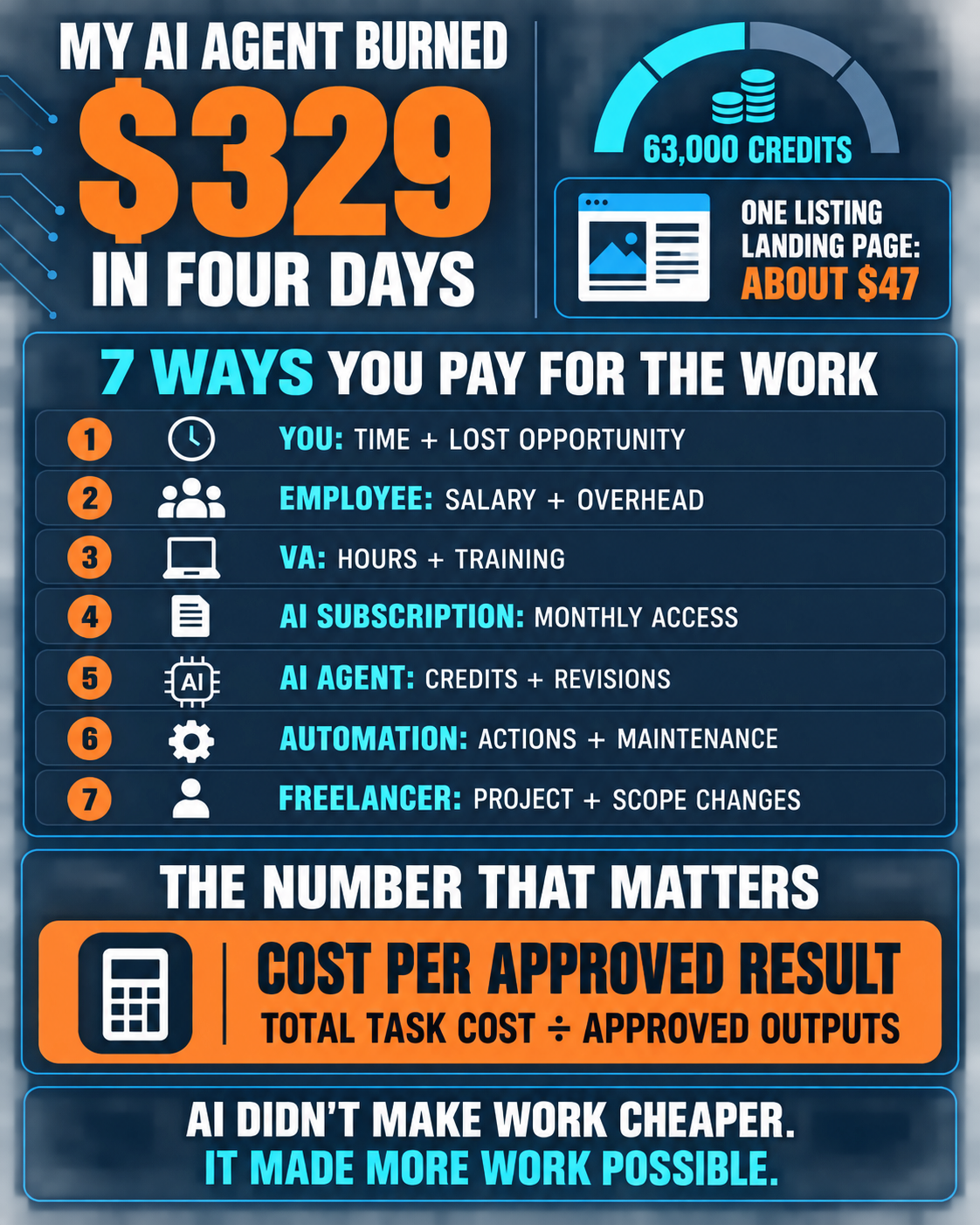
Seven ways Realtors pay for work and the cost-per-approved-result formula
You do it yourself
This feels free because no invoice arrives.
It is often the most expensive option.
Your cost includes the time spent doing the task, the time required to switch into the task, and the income-producing work you did not complete. If you spend an hour formatting a flyer, that hour is unavailable for follow-up, appointments, negotiations, or referral relationships.
Some tasks belong with you. A listing presentation, negotiation strategy, pricing conversation, or call with a nervous client depends on your experience and judgment.
Routine production work usually does not deserve your highest-priced hour.
You pay an employee or personal assistant
An employee gives you ongoing capacity. A strong personal or executive assistant learns your priorities, protects your calendar, coordinates people, handles changing instructions, and makes decisions when the plan shifts during the day.
You pay for more than the hours spent on one task. The full cost includes salary, payroll expenses, benefits, equipment, software, management, training, and unused capacity.
The Bureau of Labor Statistics reported a May 2025 median annual wage of $48,310 for secretaries and administrative assistants. The median for executive secretaries and executive administrative assistants was $76,590. U.S. Bureau of Labor Statistics
That does not make an employee a poor choice. It means the employee should handle work that benefits from continuity, context, judgment, and coordination. Paying an experienced assistant to manage priorities makes sense. Paying that same person to resize 40 images might not.
You pay a virtual assistant
A virtual assistant is often paid hourly, by project, by a block of hours, or through a monthly agreement.
The visible cost is easy to understand. If a VA earns $5 or $10 per hour and a task takes one hour, the direct labor cost is $5 or $10.
The true cost includes training, supervision, corrections, communication, turnover, and idle time. A $5-per-hour VA who needs three attempts and 30 minutes of your help does not produce a $5 result.
VAs work well for repeatable computer tasks with clear instructions and visible quality standards. Examples include loading approved content, checking web pages, organizing files, preparing marketing materials from a template, updating records, and editing videos.
The better the process, the better the economics.
You pay a flat AI subscription
A standard AI subscription often looks like a fixed monthly expense. You pay for access and work within usage limits.
This model fits writing, summarizing, organizing, brainstorming, calculation, research assistance, and continuing conversations. The system does not need to operate websites or move through several pieces of software.
The cost per task drops as useful volume rises. A $20 subscription used for 100 approved tasks represents 20 cents per approved task. The same subscription used once costs $20 for that task.
Usage limits still matter. So does review time. A low subscription price does not make inaccurate work inexpensive.
You pay an AI agent with credits
An AI agent completes multi-step work across websites, files, browsers, and software. Instead of paying by the hour, you often pay through credits.
The word “credit” makes the expense feel abstract. It still represents money.
Manus explains that its credits cover language-model tokens for planning and output, virtual machines for browser and file work, and third-party services used during a task. Credit use depends on complexity and duration. Manus also states that it does not currently provide a reliable task-cost estimate before the work begins. Manus credit rules Manus cost-estimation guidance
That creates variable labor cost. The monthly plan price stays visible, while the number of tasks the plan produces changes with the work.
You pay traditional automation by action
Some software charges for tasks, steps, records, or successful actions. This works well when the process follows fixed rules.
A form submission creates a contact. A tag starts a follow-up sequence. A completed appointment creates a task. A new lead triggers a notification.
Traditional automation does not need to think. That makes it cheaper and more predictable for simple, repeatable work. Problems appear when a workflow contains too many paid steps or when one event triggers several unnecessary actions.
The lesson is the same. Count the full process, not the first step.
You pay a freelancer by project
A fixed project fee creates a clear price for a defined result. This works well for occasional jobs such as a website redesign, presentation, video package, photography project, or database cleanup.

More Closings. Fewer Financing Surprises.
Tired of deals dying because your buyer's lender dropped the ball? Keith is the mortgage partner listing agents call when they need deals protected, difficult files approved, and buyers who show up pre-qualified.
The advantage is cost certainty. The weakness is scope. Changes, revisions, and unclear instructions often increase the final bill.
Fixed-price work performs best when the deliverable, deadline, revision limit, and approval standard are written before work starts.
The $47 Listing Landing Page I Made
My Manus plan costs $329 per month and includes 63,000 credits. That equals about $0.00522 per credit.
One of those projects was a listing landing page I made. The page gave the property its own focused place online instead of relying only on a portal or social media post. The build consumed about 9,000 credits.
The calculation looks like this:
63,000 credits divided by 9,000 credits per listing landing page equals seven listing landing pages.
$329 divided by seven listing landing pages equals $47 per page.
Seven listing landing pages at that usage level would consume the entire monthly plan. A larger page, extra revisions, or other agent work would reduce the number further.
That does not automatically make the agent too expensive.
If the $47 includes the property layout, listing photos, page branding, lead form, integrations, search optimization, schema, mobile formatting, testing, and publication, the price might make sense. If the property information, strategy, message, and copy are already approved, paying the agent to rethink them creates duplicate expense.
This listing-page example is not about handing AI my ideas and asking it to speak for me. I supplied the direction and approved message. The page used approved property information and listing materials. The agent handled the computer work required to turn those materials into a functioning page.
The job must be defined before the price has meaning.
“Build this listing landing page” might mean placing approved property information into an existing template. It might also mean creating the layout, organizing the listing photos, applying the page branding, connecting the lead form, adding tracking, applying structured data, checking the mobile version, testing the links, and publishing the finished page.
Those are not the same task.
The Advertised Price Is Almost Never the Real Price
Every worker has hidden costs.
Doing it yourself includes opportunity cost.
An employee includes payroll expenses, management, and unused capacity.
A VA includes training, communication, and quality control.
An AI subscription includes usage limits and human review.
An AI agent includes credits, failed runs, corrections, and unpredictable task depth.
Automation includes paid actions, maintenance, and broken connections.
A freelancer includes revisions and scope changes.
This is why comparing a $329 AI subscription with a $10 hourly VA tells you almost nothing. One number buys a pool of variable computer work. The other buys an hour of human labor. Neither number tells you how many acceptable results you will receive.
Measure Cost per Approved Result
Many business owners measure how many things their AI completed. A better question is how many of those things they would confidently show a client.
Use this formula:
Total task cost = direct labor or credits + software + setup + supervision + corrections + failed attempts
Then calculate:
Cost per approved result = total task cost divided by the number of outputs you would confidently use
The word “approved” matters.
Ten AI-generated listing descriptions have little value if six contain unsupported property claims. Twenty social posts do not help if none sound like you. An automated CRM update is not finished when information lands in the wrong record.
Activity is not the result.
Compare the Workers With the Same Test
Take one recurring task and run it at least ten times. Use the same instructions and the same approval standard.
Track:
- Direct cost
- Completion time
- Your supervision time
- Number of corrections
- Failed attempts
- Approved results
- Cost per approved result
Then compare the options.
For example, test ten open-house flyers through a VA, a template-based automation, and an AI agent. Confirm the property facts, brand standards, turnaround time, and total cost for each approved flyer.
Do the same with CRM notes, listing descriptions, market reports, database cleanup, landing-page production, or short-form video editing.
One impressive demonstration proves that a workflow worked once. Ten comparable runs start to show whether it belongs in your business.
Match the Payment Method to the Work
Different tasks deserve different workers.
| Type of work | Best place to start | What you are paying for |
|---|---|---|
| Negotiation, advice, and sensitive client conversations | Realtor | Judgment, trust, and responsibility |
| Changing priorities and team coordination | Personal or executive assistant | Context, continuity, and decision-making |
| Repeatable computer work with clear instructions | Virtual assistant | Human execution and quality control |
| Writing, summarizing, organizing, and analysis | Standard AI subscription | Fast reasoning without browser execution |
| Fixed data movement between systems | Traditional automation | Predictable rule-based actions |
| Multi-step browser, file, and software work | AI agent | Autonomous execution across changing steps |
| Defined occasional deliverable | Freelancer | Specialized work at a fixed project price |
The cheapest worker is not always the right worker. The most advanced worker is not always the right worker either.
A Realtor should remain close to work involving negotiation, client trust, private information, property facts, financial claims, and legal responsibility. Routine formatting should not consume the Realtor's best hours. Simple data movement should not use an expensive reasoning agent when a fixed automation handles the job.
Route the task based on value, risk, frequency, and the cost of an approved result.
Protect the Work That Is Hard to Replace
The $329 did not prove AI agents were a bad investment. It exposed a measurement problem.
My voice is difficult to replace. My judgment is difficult to replace. My relationship with a nervous buyer, seller, or referral partner is difficult to replace.
Formatting a flyer is replaceable. Pulling a report is replaceable. Building a landing page from an approved message is replaceable.
The goal is not to automate everything. The goal is to protect the work where your experience, judgment, and relationships create the most value.
Do not measure how many things your AI completed. Measure how many results you would confidently show a client, what each approved result cost, and which business outcome it created.
AI agents work. That is no longer the interesting question.
The useful question is whether the completed task was worth what you paid for it.
Sources
These links support the regulated, policy, or time-sensitive claims in this alert. Confirm current rules directly with the named source.
- U.S. Bureau of Labor Statistics: Secretaries and Administrative Assistants
The article cites the Bureau of Labor Statistics' May 2025 median annual wage data for secretaries, administrative assistants, executive secretaries, and executive administrative assistants.
- Manus Help Center: Credit consumption rules
Manus explains that credit use can include language-model tokens, virtual machines, and third-party services used during a task.
- Manus Help Center: Task cost-estimation guidance
Manus explains that a reliable task-cost estimate is not currently available before a task begins.
Frequently Asked Questions
How should a Realtor compare an AI agent with a virtual assistant?
Run the same recurring task through both options at least ten times with the same instructions and approval standard. Track direct cost, completion time, your supervision time, corrections, failed attempts, approved results, and cost per approved result. A monthly subscription or hourly rate by itself does not show the full cost.
What is cost per approved result?
Cost per approved result is the total cost of a task divided by the number of outputs you would confidently use. Include labor or credits, software, setup, supervision, corrections, and failed attempts before dividing by approved outputs.
Does a lower monthly AI price mean the work is cheaper?
No. A low monthly price can still lead to an expensive result when usage limits, review time, failed runs, or revisions pile up. The useful comparison is the cost of a completed and approved output, not the advertised access price.
When does an AI agent make sense for a Realtor?
An AI agent can fit multi-step work across websites, files, browsers, and software when the desired result and approval standard are clear. It is most useful when the computer work saves high-value time and the cost per approved result makes sense for the business.
Which real estate tasks should stay with the Realtor?
Keep negotiation, advice, sensitive client conversations, private information, property facts, financial claims, and legal responsibility close to the Realtor. These tasks depend on judgment, trust, and accountability that a routine workflow cannot replace.

Keith has helped 2,980+ families close on homes across 12+ markets over 24+ years, with $310M+ in closed loans. He specializes in difficult files, listing-agent partnerships, and the kind of complex deals most lenders turn away.
He writes the Realtor Money Alerts to give agents the plays, programs, and systems that protect deals and generate more closings.
Want plays like this every week?
Drop your email and I'll send you the next one first.
Let's Talk About Your Business
If you want to see if we can get more buyers and sellers for you, a 15-minute call is all it takes. No pitch. No pressure. Just a real conversation about your business.
Keith works with a small number of agents in each market. If there is a fit, you will know by the end of the call.
"Keith helped us get an offer on a $2.8 million dollar listing in Arrington, TN with a custom funnel. Incredible results."
"Keith has been instrumental in the growth of our listing leads coming in. He is a true partner."
We help you grow your business and get you more clients · Keith Goeringer NMLS #488023 · No obligation