

- ✓The first quarter is built during the final quarter of the year, not after the calendar turns to January.
- ✓Use two simple windows, Close This Year and Build Q1, so every buyer, seller, past client, and credit cleanup client has a clear place in your CRM.
- ✓Record why a person is waiting, schedule the next contact before the current conversation ends, and keep providing useful information while their timeline develops.
- ✓A stale listing needs attention, marketing, and sometimes a price adjustment. A lender becomes helpful when the Realtor needs to understand whether a financing incentive creates a useful payment story.
- ✓Start with five real conversations each working day. The goal is not to pressure people. It is to stay useful and present until their timeline becomes real.
There is a predictable point every year when real estate starts to slow down. I do not mean buyers disappear or sellers disappear. I mean agents slow down. By October, and especially once November and December arrive, I see fewer outbound calls, fewer personal texts, fewer conversations being started, and less proactive follow-up. Through most of the year, agents are willing to call people, text people, work old leads, and create opportunities. Then the holidays show up and a lot of that activity quietly stops.
That decision affects more than November and December. It changes January, February, and March. I have spent more than 20 years working in mortgage and real estate, and one lesson has become clearer over time: the first quarter does not begin January 1. The first quarter is built during the final quarter of the previous year. That is why I work fall as two overlapping seasons. Close This Year covers people who still have a realistic chance of buying, selling, refinancing, or closing before December 31. Build Q1 covers the people who are not moving today, but are already somewhere on the path toward moving next year.
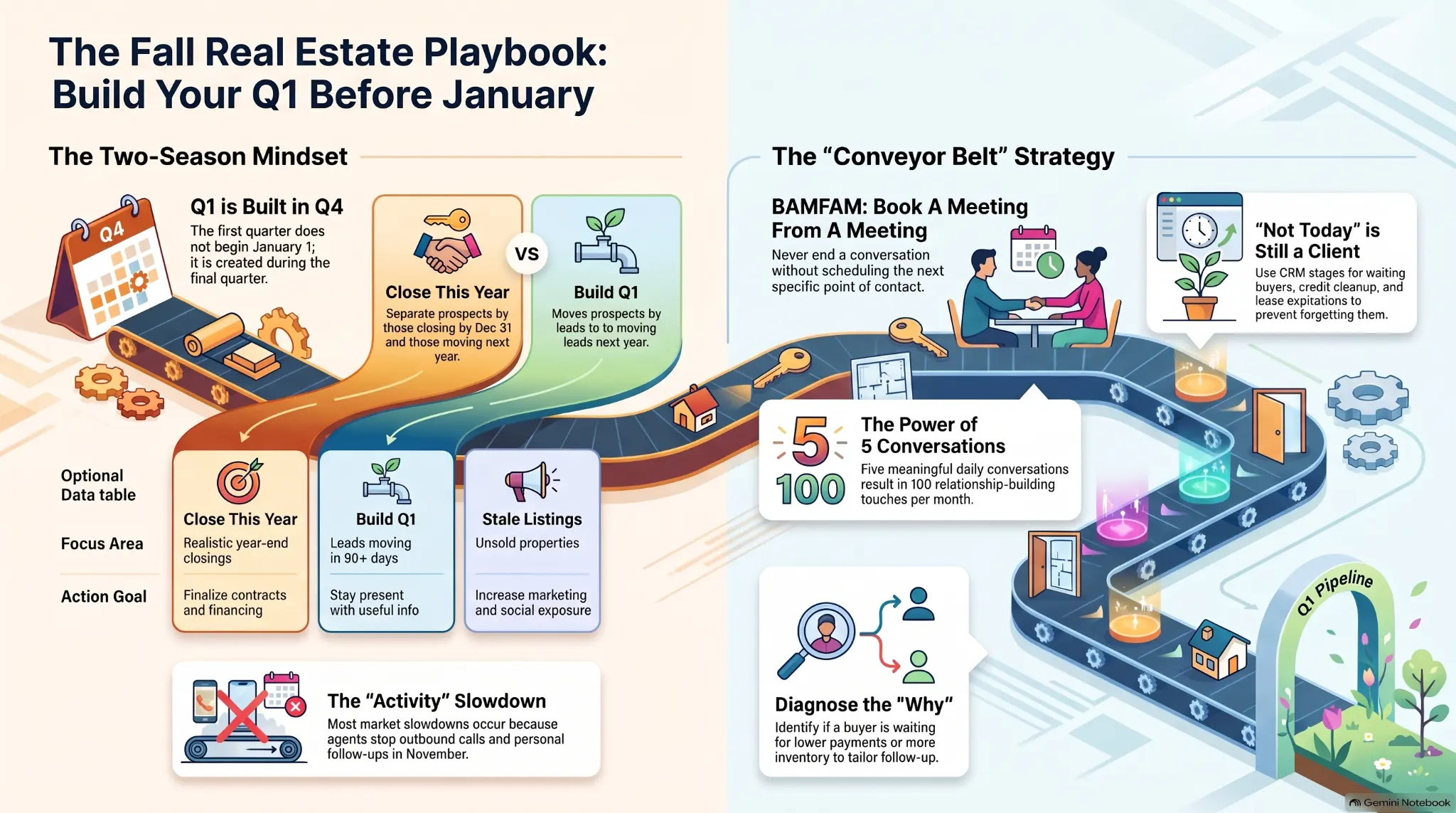
Fall Real Estate Playbook: Close This Year, Build Q1, and the Conveyor Belt Strategy
A training program I recently reviewed describes a similar idea with two fall windows, one focused on year-end closings and another focused on building January and February business. The concept is right. The bigger opportunity is learning how to manage the people inside those two windows. The people are already there. Your job is to keep them moving.
This post breaks down exactly how. By the end, you will know how to: Recognize the real fall slowdown, and why part of it is within your control Organize prospects into 90-day windows so fewer people get forgotten Build CRM stages for waiting buyers, credit cleanup clients, and future sellers Use a conveyor-belt system where every conversation creates the next one
Diagnose the reason behind every "I'm waiting" Work stale listings with marketing first, price where needed, and financing where it fits Make your database the center of your fall strategy Let's get into it.
1. The Fall Slowdown Is Usually an Activity Problem
I hear agents talk about the fall market slowing down as if somebody flipped a switch. Sometimes transaction volume does slow. Seasonality is real. But there is another slowdown happening at the same time, and agents have much more control over it. They stop doing outbound work. The calls that happened every week in April suddenly stop happening in November. Personal follow-up gets replaced by a mass email. Old leads sit in the CRM. Buyers who said "maybe later" stay there until somebody remembers them next spring.
The problem is that the damage does not always show up right away. Current transactions are still moving. Closings already under contract are still happening. The agent might even feel busy. Then January arrives. The conversations that should have happened in November never happened. The follow-up that should have happened in December never happened. The appointments that could have been waiting in January were never created.
Now the agent has to restart the entire machine. I would rather keep the machine running. I have multiple people right now who started talking with me in September and October and have not pulled the trigger yet. Some of them will. I fully expect some of those conversations to turn into November and December business. That is why I do not look at a person who is "not ready yet" as somebody who disappeared.
They are still moving through the process.
2. Think in 90-Day Windows
Real estate makes more sense to me when I look at it in roughly three-month cycles. Either someone has a reasonable chance of acting during the next 90 days, or they are being developed for the 90-day period after that. That does not mean every buyer fits perfectly inside a calendar quarter. People change their minds. Jobs change. Rates move. Houses appear. Families make decisions faster than they expected.
The point is giving every person a place. If a buyer wants to purchase before Christmas, they belong in Close This Year. If a buyer says they are thinking about March, they belong in Build Q1. If somebody tells me they are six months away, they still belong somewhere. They do not disappear. This is one of the biggest changes I have made inside my own CRM over the last year.
I now have specific stages for people who are waiting, including buyers working on credit. They stay visible. They keep receiving useful information. They keep getting marketed to. They have future follow-up dates. That change has had a tremendous impact on my business because, before those stages existed, those people were easier to forget. And I think Realtors lose a lot of business the same way.
Someone tells you they are six months out, so you mentally remove them from today's pipeline. Six months later, they buy with somebody else. The problem was not that they were six months out. The problem was that your system had nowhere to put them.
3. The Credit Cleanup Client Is Still a Client
Credit cleanup is one of the clearest examples. A buyer applies and is not ready. Maybe their score needs work. Maybe debt needs to come down. Maybe something on the credit report needs time. The natural reaction is to say, "Call me when you get this fixed." That sounds reasonable. It is also how people disappear. Instead, I want that buyer placed into a specific CRM stage. They should continue receiving useful information. Their situation should have a future review date. Somebody should know what needs to happen next and when we are going to talk again.
I only built these credit cleanup and waiting stages into my CRM within the last year, and doing that has grown this part of my business significantly. The buyer never becomes an old lead sitting somewhere at the bottom of a database. They are still a client. They are simply in a different stage.
The same principle applies beyond credit:
Waiting for a lease to expire is a stage Waiting for inventory is a stage Waiting for a lower payment is a stage Preparing to sell next spring is a stage Saving more money is a stage Waiting for a job change is a stage The core idea: "Not today" should never turn into "forgotten." That is a CRM problem, not a lead-generation problem.
4. Nobody Gets Off the Conveyor Belt
This is how I picture the entire process. Everyone is on a conveyor belt. A conversation creates another conversation. A meeting creates the next meeting. A buyer does not finish a Zoom with me and then fall into a black hole until somebody remembers to call them three months later. We set the next point of contact while we are already talking.
I sometimes refer to this as BAMFAM. Book a meeting from a meeting. If somebody tells me they want to revisit buying in three months, the next touch gets created. Today, we even use AI agents with Google Calendar to help manage some of this. I might tell the system, "In three months, create an appointment for me to call or text this person."
The technology helps, but the technology is not the important part. The philosophy is. Every conversation should create the next action. Maybe that action is tomorrow. Maybe it is next month. Maybe it is 90 days away. The timeframe should come from the client's situation, but there should still be something scheduled. Write it down: Do not leave the next conversation to memory. Memory is terrible CRM software.
They often come back before you call
The funny part is that many buyers come back before the scheduled follow-up date. I see this all the time. Someone sits out for months. We keep marketing to them and keep giving them useful information. Then one Saturday they text me:
> "Hey, we're actually looking to buy a house."
Or:
> "We found one. We want to put an offer in this weekend."
They came back before my scheduled call because we never disappeared. That is exactly what I want. I am not trying to predict the precise day somebody becomes ready. I am trying to stay useful and present enough that, when that day arrives, I am the person they contact.
5. "What Is Your Timeframe, and Why?"
When somebody tells me they are waiting, I do not spend much time trying to convince them they should stop waiting. I want to understand the timeframe. Then I want to understand why that timeframe exists. That second question matters. A buyer might say, "We are waiting until spring." Okay. Why spring?
Maybe they believe rates will be lower. Maybe they need the monthly payment to come down. Maybe they think more homes will hit the market. Maybe they need more money. Maybe their lease ends in April. Maybe spring is simply a date they picked because buying right now feels uncertain. Those are completely different situations. The two things I see buyers waiting for most often are lower payments and more inventory.
Once I know the real reason, follow-up becomes easier. If payment is the problem, the buyer stays in a waiting stage and we keep providing useful information. If rates move, home prices change, concessions appear, or their target area changes, we rerun the numbers. If inventory is the problem, watch the inventory. If the lease ends in April, work backward from April.
If they need more cash, keep an eye on the numbers and revisit the strategy later. The buyer has already given you the follow-up plan. You do not need to invent one. The mistake is putting everybody into the same nurture campaign and sending "Just checking in" messages every few weeks. Your CRM should know why each person is waiting.
That reason should determine what happens next.
6. Give, Give, Give Until They Raise Their Hand
Someone who tells you they want to buy next spring does not need to hear "Are you ready to buy?" every month. They already told you the answer. Instead, keep providing useful information. This is where marketing and follow-up start becoming the same system. Give them ideas. Give them market information when something meaningful changes. Give them homeowner information. Give them financing strategies. Give them useful local information. Give them something that makes owning, selling, buying, or planning their next move easier.
Then let them raise their hand. This is how many of my old buyers come back. They have been receiving information. They know I am still here. They know how to reach me. Then something changes in their life and they respond. That is far more effective than repeatedly asking somebody for a decision they already told you they were not ready to make.
Generic market updates are losing their value
I am not against market updates. I send them myself. But I do not think sending a list of statistics simply because another week passed gives somebody much value. If something changes dramatically, talk about it. If rates move enough to matter, talk about it. If inventory shifts enough to affect buyers, talk about it. If there is a marketing idea a Realtor could use with a listing, talk about it.
The question I try to ask is simpler: What information would make this person's life easier?
For Realtors, that is often a marketing idea, a client conversation, a financing strategy, or something practical they could use in their business. For buyers, it might be understanding the payment. For homeowners, it might be understanding equity or options. For sellers, it might be another way to get more attention on a property. A number without an action attached to it is rarely useful.
7. Payment Deserves More Attention Than Price

More Closings. Fewer Financing Surprises.
Tired of deals dying because your buyer's lender dropped the ball? Keith is the mortgage partner listing agents call when they need deals protected, difficult files approved, and buyers who show up pre-qualified.
Real estate naturally talks about price. Buyers live with the payment. That creates an interesting problem for Realtors because payments move. Rates move. Taxes differ from one property to another. Insurance differs. HOAs differ. A $500,000 house does not have one universal monthly payment. That is one reason a strong loan officer matters inside the buyer process. When a buyer says, "I need the payment to come down," the Realtor should not have to guess how much a $10,000 price change matters.
Run it. Look at the actual property taxes. Estimate the insurance. Add the HOA. Look at the loan structure. Look at available seller contribution. Then decide whether the house still works. This is also why I am careful with broad statements like "fall is a better time to buy." Better for whom?
A buyer who needs $500 taken off the monthly payment has a different problem from a buyer who wants three more homes to choose from. One needs payment strategy. The other needs inventory. Good strategy begins with the specific constraint.
8. Stale Listings Usually Need More Attention, Not Less
When I look at stale listings, I tend to think marketing first. Get the property in front of more people. Put it into relevant social media groups. Create more content around the house. Run Meta ads. Use Google where it makes sense. Use YouTube. Keep finding ways to create attention around the property. And I am still a big believer in open houses.
I think open houses are one of the strongest tools Realtors have for generating activity around a listing. They give buyers another reason to visit, create additional content opportunities, and give the agent a reason to talk about the property again. If something is sitting, my first instinct is not to stop talking about it. My instinct is to talk about it more.
But more exposure does not fix a property priced above what buyers are willing to pay. Eventually, price matters.
Where I differ on concessions
This is where I differ a little from some of the popular conversation around seller concessions. I think concessions are interesting. They can be a great hook. A financing incentive might catch somebody's attention. It might cause a buyer to click on a property they previously ignored. It might make a payment scenario look much more attractive once that buyer starts considering the house.
What I am less convinced of is that the concession itself is what ultimately moves the property. Price reductions still get attention in a different way. If a buyer sets their search at $600,000, they are not seeing the $625,000 listing simply because the seller is offering a financing concession. Drop that property into the buyer's price range and suddenly it shows up.
That matters. So I would not turn every stale listing into a complicated lender exercise. Price is the Realtor's lane. Marketing is the Realtor's lane. Where the lender becomes useful is when the Realtor wants to know whether a financing incentive gives the property another compelling story. That is worth exploring.
Stay in your lane, but make the lanes work together
I do not think a lender needs to be involved every time a Realtor considers reducing a price. The listing agent understands the property, the competition, the seller, showing feedback, and the local market. Those decisions belong with the Realtor and seller. The lender has a different set of tools. If the Realtor wants to advertise a financing incentive, compare different concession structures, or understand how a certain seller contribution affects a buyer's monthly payment, bring the lender into the conversation.
That is where the relationship helps. Build this habit: Good Realtor-lender relationships do not require everybody to do everybody else's job. They require knowing when another person's expertise improves the decision.
9. Your Best Months Come From Taking Care of the Leads You Already Have
When I look back at my strongest months, the answer is usually not some giant influx of new leads. It is consistency. We took care of the people who came in. We followed up. We helped them. We kept them organized. We stayed in front of the people who were not ready. Then those people created referrals. That is why I think Realtors sometimes overcomplicate business development.
Lead generation matters. You need people coming into the business. But there is another question that matters just as much: What happens after the lead arrives?
If somebody spends thousands of dollars generating leads and then stops outbound follow-up in November, the lead source is not the biggest problem. The follow-up system is. If you have 500 old leads sitting in a CRM with no clear stage, no future contact date, and no reason recorded for why they stopped, buying another 500 leads does not solve that.
It simply gives you 1,000 people to forget. Clean up the conveyor belt first.
10. Fall Is the Best Time to Find the Forgotten People
October, November, and December are great months to open the CRM and look for the people nobody has talked to recently. Look at old preapprovals. Look at buyers who lost houses. Look at people who hated their payment. Look at future sellers. Look at past clients. Look at credit cleanup. Look at people waiting for leases to expire. Look at anybody who said "next year."
Then organize them into your two windows. Close This Year. Build Q1. The original Secret Season workbook recommends separating prospects based on whether they have a path toward acting during the current fall window or are more likely to become January and February business. It also makes the distinction that conversations are the activity while appointments are the goal.
I think that framework works. I would simply put a much stronger CRM process underneath it. The machine: Every person needs a stage. Every stage needs a reason. Every reason needs a future action. Every conversation needs a next conversation. If your CRM cannot tell you those four things, fix that before you buy more leads.
11. Five Conversations a Day Is Enough to Change Q1
You do not need to spend eight hours a day calling your database. Start with five real conversations. Not five voicemails. Not five mass emails. Five conversations where you learn something and move the relationship forward. Maybe the buyer still wants to move but needs a lower payment. Maybe the seller wants to list after Christmas. Maybe a credit score is improving. Maybe the lease expiration moved up. Maybe the family needs another bedroom. Maybe a Realtor needs help getting attention on a listing.
Each conversation should move somebody somewhere. At five conversations per working day, you end up around 100 conversations in a month. The training materials use 50 conversations as a floor and 100 as a stretch target, with appointments as the outcome being pursued. That is useful because it shifts the scoreboard. Calls do not pay you. Conversations by themselves do not pay you either.
Conversations create appointments. Appointments create clients. Clients create transactions. Well-served clients create referrals. That is the flow I care about. And when you keep that flow moving in October, November, and December, Q1 feels completely different.
12. Book the Next Conversation Before This One Ends
If there were one operational habit I would want every Realtor to steal from this article, it would be this: Do not end a good conversation without knowing what happens next. Maybe the next action is tomorrow. Maybe it is 30 days away. Maybe it is three months away. The timing should come from the client's situation. But schedule something.
If somebody says, "Call me after Christmas," put it in the system while you are talking. If somebody says, "Let's revisit this in February," create the February follow-up. If the buyer needs three months to work on credit, set the review now. Do not trust yourself to remember. If you use an AI agent, let the agent create the future calendar task. If you use CRM workflows, automate the reminder. If you manage your follow-up manually, put the date in yourself.
The technology is secondary. The rule is what matters. Everybody stays on the conveyor belt.
13. Build Q1 by Helping People Who Do Not Look Like Opportunities Yet
Close This Year is easy to understand because those people already look like business. They are active or almost active. Build Q1 takes more discipline because many of those people do not look like opportunities right now. That is exactly why they matter. A past client might have no current plans to move. Give them something useful. A homeowner might casually mention downsizing next year. Stay in touch.
A buyer might tell you they want to wait until February. Fine. Keep giving them relevant information. A client working on credit might need six months. Keep them visible. This group does not need pressure. They need presence and value. The goal is being the person they already know when their timeline becomes real. That is what the training describes as "shortlist season." January and spring business often begins months earlier, while many other agents are waiting for January to start prospecting again.
I have seen this repeatedly. The transaction might happen in March. The relationship was often won months earlier.
What to Do This Week
If I were working with a Realtor on this tomorrow, I would not begin with a giant marketing calendar. I would begin with the database. Create two main groups, Close This Year and Build Q1. Then go through the people who have stalled and document why they stalled.
From there:
Put waiting buyers into clear CRM stages Keep credit cleanup clients visible Record why each person is waiting Schedule future contact while you are still talking with the client Give waiting clients useful information instead of repeatedly asking if they are ready Keep outbound calls and texts going through October, November, and December Work stale listings with more marketing, social exposure, advertising, and open houses
Use price reductions when price is the issue Bring financing incentives into the conversation when they create a useful marketing angle Track conversations, appointments, applications, transactions, and referrals Aim for five meaningful conversations every working day Then review the system every week. Who moved forward? Who needs another conversation? Who belongs in Q1 now? Who needs more time on credit? Who raised their hand before the scheduled follow-up? Who sent you somebody else?
That weekly review matters because a CRM should never be a storage unit for old leads. It should tell you what happens next.
The Fall Pipeline Playbook
The Fall Is Not the Time to Disappear
There is nothing wrong with enjoying the holidays or taking time off. The mistake is letting your business disappear for two or three months and assuming January will somehow fix itself. January only has what you put into it. When I look at my own business, the biggest opportunity is usually not finding thousands more people. It is taking better care of the people who already found us.
Keeping them organized. Keeping them informed. Keeping the relationship alive. Giving them useful information while they wait. Making sure nobody quietly falls off the conveyor belt. That is what I want Realtors thinking about this fall. Do not spend October, November, and December wondering where the market went. Open your database. Your first quarter is probably already sitting inside it.
Sources
These links support the regulated, policy, or time-sensitive claims in this alert. Confirm current rules directly with the named source.
- Consumer Financial Protection Bureau: Loan Estimate Explainer
The CFPB explains that total monthly payment can include mortgage insurance and escrow, while property taxes and homeowners insurance can affect the expected cost. A Loan Estimate is the official form for reviewing requested loan terms and costs after application.
Frequently Asked Questions
What do Close This Year and Build Q1 mean?
Close This Year is for people with a realistic path to buying, selling, refinancing, or closing before December 31. Build Q1 is for people who are not moving today but are on a path toward acting early next year. The point is giving every person a visible place instead of letting them disappear.
How should a Realtor handle a lead who is not ready yet?
Put the person in a specific CRM stage, record why they are waiting, give them useful information, and set a future review date. A buyer working on credit, waiting for a lease to expire, saving more money, or thinking about spring is still a client in a different stage.
What should I record in a CRM stage?
Record the client’s reason for waiting, the relevant timing, the constraint that needs to change, and the next action. That makes the next conversation more useful than a generic check-in message.
Why schedule the next conversation while I am already talking to someone?
The current conversation gives you the timing and reason for follow-up. Create the next call, text, calendar task, or CRM reminder before the conversation ends so it does not rely on memory.
Is five conversations a day enough?
This alert uses five meaningful conversations per working day as a practical starting point, not a universal quota. The goal is to learn something and move each relationship forward, then measure whether those conversations are creating appointments and clients.
When should a lender be involved with a stale listing?
A Realtor and seller make the pricing decision. Bring in the lender when a financing incentive, seller contribution, or property-specific payment question could create a clearer marketing angle for a potential buyer.

Keith has helped 2,980+ families close on homes across 12+ markets over 24+ years, with $310M+ in closed loans. He specializes in difficult files, listing-agent partnerships, and the kind of complex deals most lenders turn away.
He writes the Realtor Money Alerts to give agents the plays, programs, and systems that protect deals and generate more closings.
Want plays like this every week?
Drop your email and I'll send you the next one first.
Let's Talk About Your Business
If you want to see if we can get more buyers and sellers for you, a 15-minute call is all it takes. No pitch. No pressure. Just a real conversation about your business.
Keith works with a small number of agents in each market. If there is a fit, you will know by the end of the call.
"Keith helped us get an offer on a $2.8 million dollar listing in Arrington, TN with a custom funnel. Incredible results."
"Keith has been instrumental in the growth of our listing leads coming in. He is a true partner."
We help you grow your business and get you more clients · Keith Goeringer NMLS #488023 · No obligation