

- ✓Your deal history becomes hard to use when the details are scattered across old emails, texts, transaction systems, and your memory.
- ✓Create one private entry for each meaningful transaction. Save the situation, the problem, what you tried, the turning point, the outcome, and what you learned.
- ✓Add short notes while the transaction is moving. By closing, the story is already mostly recorded.
- ✓Use AI to interview you after a deal and organize your answers into a useful record instead of starting from a blank page.
- ✓Keep detailed records private. When a lesson is worth sharing, remove identifying and confidential details before creating a public case study, then use it for content, training, and proof of experience.
I've been in real estate and mortgage for 24 years. And lately I've been thinking about how many deals I've forgotten. Not all of them. Some clients and transactions stick with you forever.
The difficult ones. The emotional ones. The strange ones. The deals that looked dead and somehow made it to closing. But there are hundreds of other transactions where I barely remember the details anymore.
That bothers me. Because every deal has a story. Someone needed help. Something went wrong. A problem had to get solved.
An inspection uncovered something nobody expected. An appraisal came in low. Financing changed at the last minute. A buyer got nervous. A seller refused to move.
A title problem appeared. A closing almost fell apart. Then somebody figured out how to move the deal forward. Six months later, everyone is already focused on the next transaction.
After Enough Years, The Details Start Disappearing
A huge part of your career ends up buried inside old emails, CRM notes, transaction systems, text messages, and your memory. Then your memory starts losing the details. I probably average five or six transactions a month. That's dozens of stories every year. Over 24 years, there are countless deals I've solved, helped rescue, worked through, or learned from where I no longer remember exactly what happened.
I wish I had documented more of them. So here's what I think Realtors should start doing. Document your deals. Not only your listings. Not only your closings.
Document the story.
Your Career Is Happening Right Now
Real estate moves fast. You close the transaction. You get paid. You move on. But the transaction contains something more valuable than the commission.
Experience. Think about what you learn after ten years of selling real estate.
You see strange inspections.
- Low appraisals.
- Bad repairs.
- Multiple-offer situations.
- Survey problems.
- Septic issues.
- HOA problems.
- Title issues.
- Divorces.
- Estates.
- Relocations.
- New construction delays.
- Financing problems.
- Insurance problems.
- Walkthrough surprises.
- Contract mistakes.
- Negotiations that almost collapse.
- Deals that die.
- Deals that come back together.
That knowledge builds slowly. The problem is you rarely document it. Five years later someone asks: "Have you ever dealt with something like this before?" You know the answer is yes.
You remember something similar. You do not remember exactly what happened. That's what I want to fix.
Build A Deal Journal
You do not need a complicated system. You need one place where meaningful transactions get documented. Think of it as a private deal journal. Every property gets its own entry.
Track things like:
- The client.
- The property.
- What they were trying to accomplish.
- What made the deal difficult.
- What changed.
- What surprised you.
- What you tried.
- What worked.
- What failed.
- How the deal ended.
- What you learned.
- What you would do differently next time.
You do not need to write a long article every time something happens. You need enough detail to bring the memory back later.
A simple entry might look like this:
- Spring Hill buyer.
- Needed to sell current house before purchasing.
- Inspection uncovered a major HVAC issue.
- Seller initially refused to repair it.
- Buyer almost terminated.
- Negotiated a credit instead.
- Financing had to be restructured because the credit changed available cash.
- Closing moved seven days.
- Deal closed.
That's enough. Three years later, you read those notes and the transaction starts coming back. Without them, you might never think about the deal again.
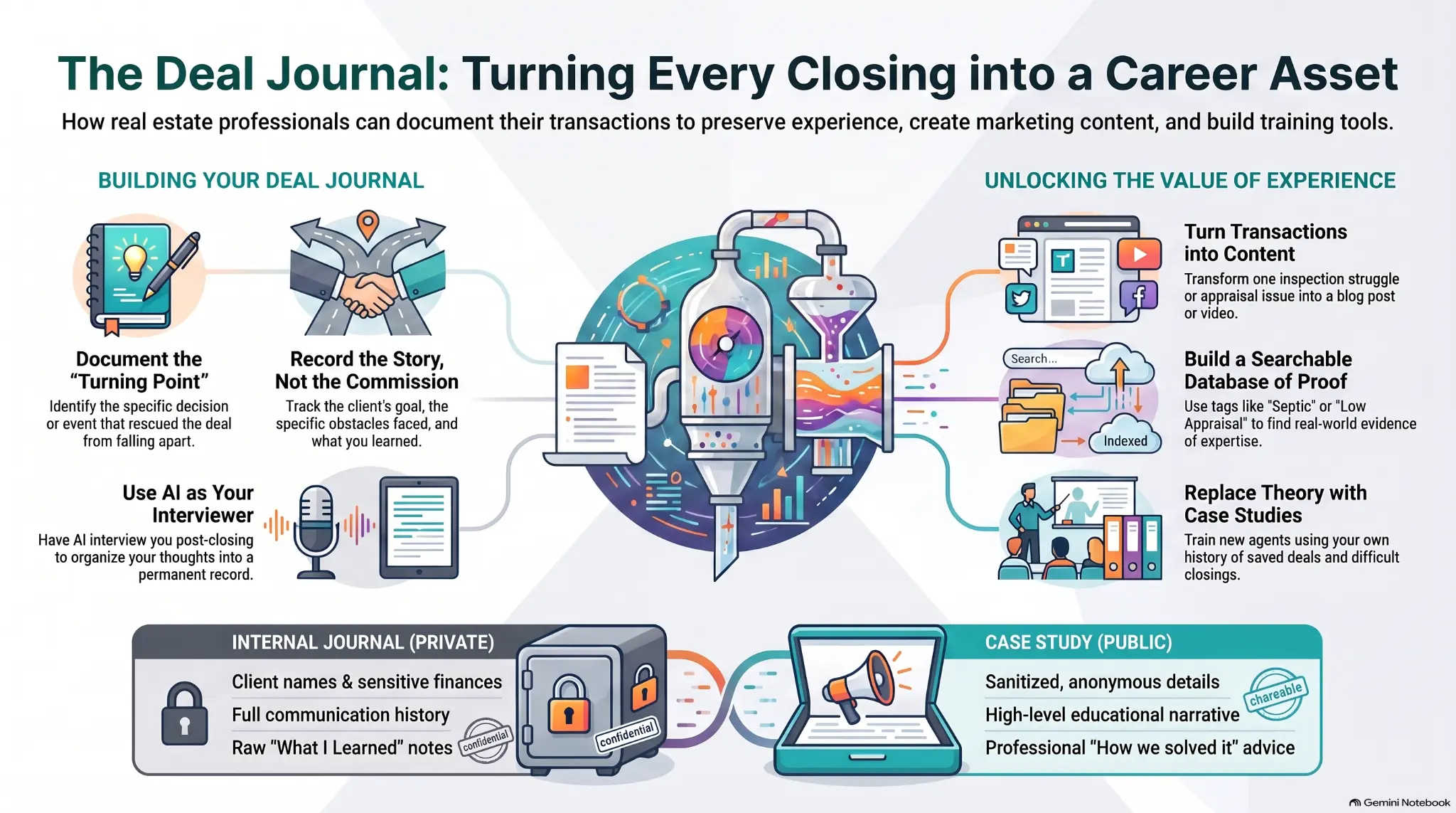
Turning closings into career assets
Document The Deal While You're Living It
Do not wait until closing. You will forget things. Add notes as the deal develops. Inspection problem? Write one sentence.
Appraisal issue? Add another sentence. Buyer gets cold feet? Document why. Seller makes an unusual decision?
Record it. Lender changes something at the last minute? Add it. Contract gets extended? Write down what happened.
By closing day, most of the story already exists. Then spend a few minutes finishing the record.
Let AI Interview You
This is where AI makes the process easier. At the end of the transaction, open ChatGPT and say: "Interview me about this deal so I have a permanent record of what happened."
Then answer the questions.
- What was the client trying to accomplish?
- What made the transaction difficult?
- When did the problem first appear?
- What did you try?
- What worked?
- What failed?
- What was the turning point?
- What did you learn?
- What would you tell another Realtor dealing with the same situation?
You talk. AI organizes the story. Now you have a useful record without sitting down and writing everything from scratch.
Document Deals That Don't Close Too
Do not build the system only around closings. Some of your best lessons come from transactions that never make it to closing. Maybe you helped someone for three months and they never bought. Maybe a title problem killed the deal. Maybe financing failed.
Maybe an inspection changed everything. Maybe the buyer walked. Maybe you advised someone not to buy the property. You still learned something. You still helped someone.
Document it. Your database should tell the story of your career, not your commission checks. Sometimes the best example of your experience is the deal where you told someone to walk away.
Every Realtor Is Sitting On A Content Library
This is where the idea starts becoming even more valuable. You do not need to keep inventing things to talk about. Your transactions already give you the material.
Look at your last 50 deals.
- One inspection story becomes a video.
- One appraisal problem becomes an email.
- One negotiation becomes a blog post.
- One title issue becomes a podcast.
- One buyer mistake becomes a Reel.
- One difficult closing becomes a case study.
- One strange property becomes an educational article.
Instead of writing another generic post called: "5 Tips for First-Time Homebuyers" write: "Why My Buyer Almost Walked Away After The Inspection" or:
"The Appraisal Came In $35,000 Low. Here's What Happened Next." or: "We Found A Septic Problem Three Days Before Closing." Those stories came from your work. They show what you have dealt with.
They show how you think. They show what you know.
Create A Private Version And A Public Version
Most of the detailed record should stay private.

More Closings. Fewer Financing Surprises.
Tired of deals dying because your buyer's lender dropped the ball? Keith is the mortgage partner listing agents call when they need deals protected, difficult files approved, and buyers who show up pre-qualified.
Your internal version might include:
- Client name.
- Property.
- Timeline.
- Referral source.
- Exact problem.
- Notes.
- Financial details when appropriate.
- Communication history.
- Final outcome.
- Lessons learned.
Then every once in a while, one of those stories is worth publishing. That gets turned into a sanitized public version. Remove private information. Remove anything identifying the client. Remove financial details you should not publish.
Remove anything the client would reasonably expect to stay confidential. Then tell the educational part of the story. A public version might say: "A buyer in Middle Tennessee found a major HVAC problem during inspection. The seller initially refused repairs. After restructuring the negotiation, both sides agreed to a credit and the transaction closed." You preserved the lesson.
You did not expose the client.
Let Some Of Those Stories Live On Your Website
This is where the idea gets more interesting. Some of those case studies could live on your website without appearing in your main menu. They still have their own pages. They still appear in your sitemap. Relevant blog posts link to them when the story helps explain something.
For example, you write an article about low appraisals. Inside the article you say: "Here's a real example of a transaction where an appraisal came in low and how we handled it." Then you link to the case study. The article teaches the concept.
The case study provides proof. Over time, your website starts showing what you have actually done. Not claims. Examples.
You Do Not Have To Put These Pages In Your Main Menu
This is an important distinction. A case study does not need to sit in your main navigation to have value. You can create the page, include it in your XML sitemap, link to it from relevant content, and leave it out of the main menu. Your website stays clean for buyers and sellers. At the same time, you slowly build a searchable archive of your actual work.
Ten years from now, your site might contain hundreds of real examples showing the problems you have handled and the people you have helped. That becomes proof. Instead of saying you have experience with low appraisals, unusual properties, difficult inspections, relocations, or complicated negotiations, you have real stories showing it. And as AI search becomes more important, this gets even more interesting. Generic real estate advice is everywhere.
Your actual experience is not.
Proof Gets More Valuable Over Time
Think about what happens after ten years of documenting deals. You might have hundreds of stories. Someone asks: "Have you worked with a buyer purchasing a home with a septic system?" Search.
You find 22 deals. Someone asks: "Have you ever had an appraisal come in low?" Search. You find 17 examples.
A client is buying an unusual property. Search. You find three transactions with similar issues. Another agent has a deal falling apart because of financing. Search.
You pull up a similar story and remember exactly how it played out. Your history becomes searchable. That's useful for your clients. It's useful for your team. It's useful for training.
It's useful for marketing. It's useful for content. And it's useful for you.
Use Tags Instead Of Building A Complicated System
You do not need dozens of categories.
Use simple tags.
- Inspection
- Appraisal
- Financing
- First-time buyer
- Multiple offers
- Low appraisal
- Septic
- Well
- Condo
- HOA
- New construction
- Relocation
- Estate
- Divorce
- Title issue
- Repair negotiation
- Investment property
- Unusual property
- Closing delay
- Deal fell apart
Later, search the tags. Done.
Create A "Turning Point" Section
I would add one section to every story called: The Turning Point This answers one question: What changed the deal?
Sometimes one decision changes everything.
- The seller agreed to the credit.
- The lender found another option.
- The buyer increased the down payment.
- The contractor produced the documentation.
- The appraiser reconsidered something.
- The title company found the missing document.
- The inspection revealed something nobody expected.
That moment is often the most interesting part of the story. It is also the part you're most likely to forget. Document it.
Add "What I Learned"
This might become the most valuable part of the system. Finish every deal with one question: What did this deal teach me?
Maybe the answer is:
- Never assume the septic permit matches the current bedroom count.
- Verify insurance earlier on older homes.
- Do not wait until the end of inspection to get repair estimates.
- Make sure the lender understands the property before submitting an offer.
- Get the survey earlier when boundary issues appear possible.
- Ask better questions about renovations.
A career is thousands of lessons like these. Write them down.
This Becomes Your Training System
Now think beyond yourself. You hire a newer agent.
Instead of teaching everything from theory, give them actual examples.
- "Read these ten deals involving low appraisals."
- "Read these five inspection disasters."
- "Look at these relocation transactions."
- "Read the three deals where financing almost killed the closing."
You are training them using your own experience. That's far more useful than another generic training video.
Your Deals Are Part Of Your Story
This started for me because I realized how much of my own career I had forgotten. Twenty-four years goes fast. You help someone. You solve the problem. You close.
Then another client needs you. Another deal starts. Another problem appears. You keep moving. Then one day you look back and realize there are hundreds of stories behind you.
People you helped. Problems you solved. Mistakes you learned from. Transactions you saved. Transactions you lost.
Families who moved. Homes that changed hands. I'd like to remember more of mine. That's why I think we should start documenting them now. Not because every deal needs to become content.
Not because every transaction needs to get published. Because your career is worth recording. And every once in a while, one of those stories becomes something else. A lesson. A training tool.
A blog post. A video. A referral story. A case study. Proof of the work you've done.
Ten years from now, I want to open a deal from 2026 and remember what happened. Who we helped. What went wrong. What we figured out. How it ended.
What I learned. You're already building the story. Start writing it down.
Sources
These links support the regulated, policy, or time-sensitive claims in this alert. Confirm current rules directly with the named source.
- National Association of REALTORS®: 2026 Code of Ethics & Standards of Practice
Article 1, Standard of Practice 1-9 addresses a REALTOR®'s continuing duty to preserve client confidential information. Applicable law and broker policy still control.
Frequently Asked Questions
What should a Realtor put in a private deal journal?
Record the client and property for your private reference, what the client was trying to accomplish, what made the deal difficult, what changed, what you tried, the turning point, the outcome, and what you learned. The goal is not a long article. It is enough detail to bring the transaction back later.
Should I document deals that never close?
Yes. A transaction can still teach you something when financing fails, an inspection changes the decision, a title problem stops the purchase, or you advise someone to walk away. Your records should capture the lessons, not only the commission checks.
When should I add notes to a deal journal?
Add a sentence when something important happens instead of waiting until closing. A short note about an inspection problem, appraisal issue, extension, or unexpected decision is easier to write while the details are fresh.
How can AI help me document a transaction?
After the transaction, ask an AI tool to interview you about what happened. Answer questions about the goal, problem, options you tried, turning point, outcome, and lesson. Then save the organized record in your private system.
Can I turn a deal journal entry into public real estate content?
Sometimes. Keep the detailed version private, then remove client names, property details, financial details, and anything a client would reasonably expect to remain confidential. Follow applicable law, your broker's policy, and the duties that apply to your relationship before publishing.
How does a deal journal help a real estate team?
Tags such as inspection, appraisal, financing, title issue, or relocation make real examples easier to find. A newer agent can learn from actual transactions your team has handled instead of relying only on generic training material.

Keith has helped 2,980+ families close on homes across 12+ markets over 24+ years, with $310M+ in closed loans. He specializes in difficult files, listing-agent partnerships, and the kind of complex deals most lenders turn away.
He writes the Realtor Money Alerts to give agents the plays, programs, and systems that protect deals and generate more closings.
Want plays like this every week?
Drop your email and I'll send you the next one first.
Let's Talk About Your Business
If you want to see if we can get more buyers and sellers for you, a 15-minute call is all it takes. No pitch. No pressure. Just a real conversation about your business.
Keith works with a small number of agents in each market. If there is a fit, you will know by the end of the call.
"Keith helped us get an offer on a $2.8 million dollar listing in Arrington, TN with a custom funnel. Incredible results."
"Keith has been instrumental in the growth of our listing leads coming in. He is a true partner."
We help you grow your business and get you more clients · NMLS #2292855 · No obligation