
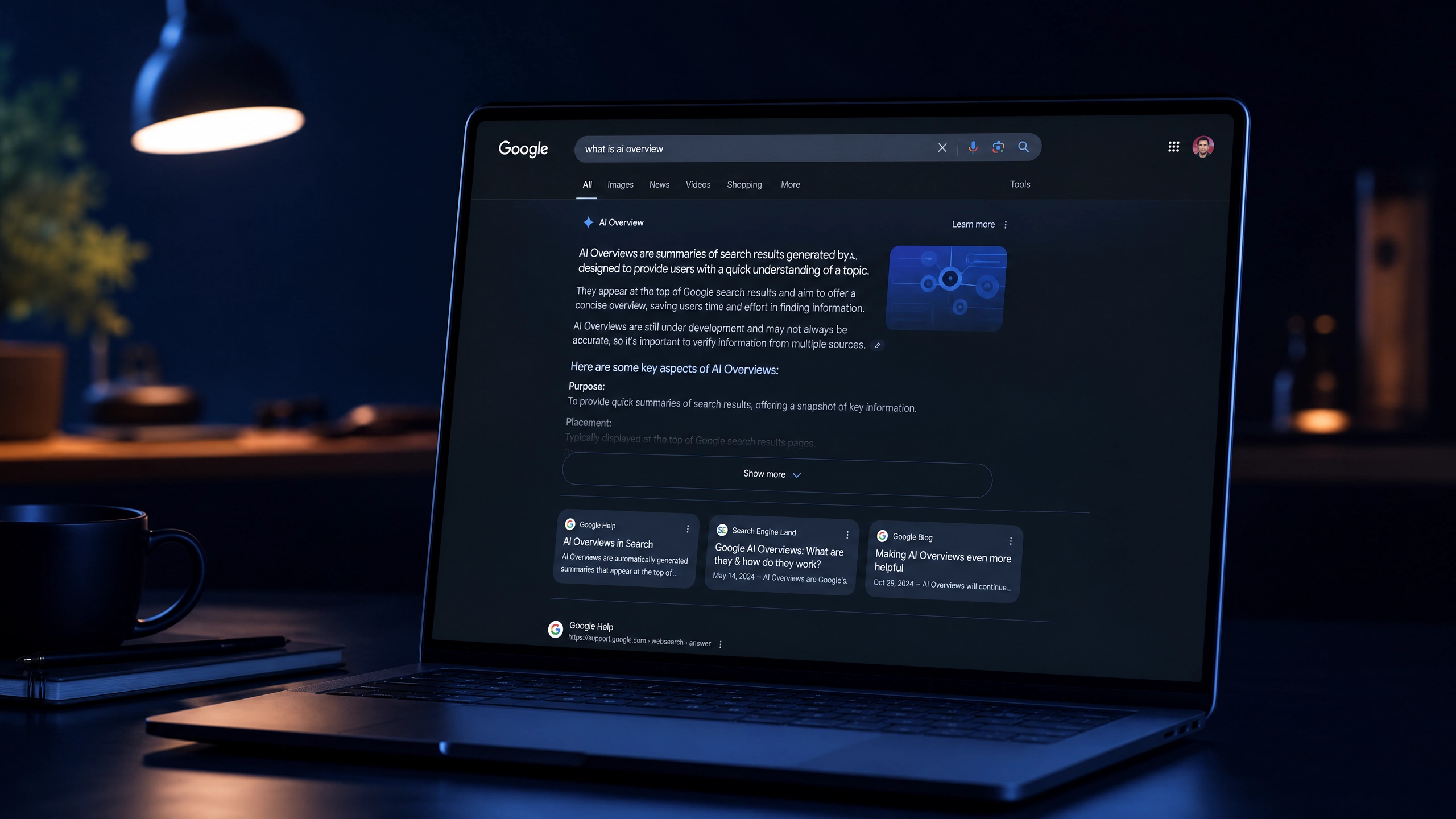
- ✓Google now answers many real estate questions through AI Overviews and AI Mode, which means Realtors are competing to become a trusted source, not just a search result.
- ✓Specificity is the foundation. Realtors who clearly describe who they help, where they work, and what problems they solve are easier for Google to understand and recommend.
- ✓Detailed reviews from real clients give Google context about your specialty, your location, and the types of clients you serve.
- ✓Blog posts, YouTube descriptions, and Instagram captions all contribute to how Google understands your positioning.
- ✓Your Google Business Profile, website, and social profiles should describe your business in consistent terms across every platform.
- ✓Building content clusters around specific client situations gives Google a clear picture of your depth and expertise.
Google is changing how it answers real estate questions.
Buyers and sellers are no longer typing short searches like "best Realtor in Franklin." They are asking longer, more specific questions like "Who is a good Realtor in Franklin for a family relocating from California who wants strong schools, newer construction, and help selling their current home?"
Google now answers many of those questions through AI Overviews and AI Mode. The consumer sees a written answer, recommended sources, videos, reviews, and business profiles. They may never click through to a website at all.
This changes what Realtors need to do to get found. You are no longer competing only for the first page of Google. You are competing to become one of the sources Google trusts enough to mention.
What Are Google AI Overviews and AI Mode?
AI Overviews appear near the top of regular Google search results. Google reviews available information, summarizes an answer, and cites the sources it used. Those sources can include websites, blog posts, YouTube videos, Instagram posts, Google Business Profiles, reviews, Reddit discussions, and local websites.
AI Mode works more like a conversation. The consumer asks a question, receives a direct answer, and continues asking follow-up questions. They might start with "Who is a good listing agent in East Nashville?" and follow up with "Which one has experience with historic homes?" and then "Which one has strong reviews and professional video marketing?"
Google can answer the full conversation without the consumer opening ten different websites. Your business needs to be part of that conversation.
Why Specificity Matters More Than Ever
Consumers are searching by neighborhood, property type, price range, life stage, relocation market, school preference, selling situation, communication style, and marketing strategy. They are not searching only by city.
A Realtor who says "I help everyone buy and sell real estate" gives Google little useful information. A Realtor who consistently says "I help California families relocate to Franklin and Williamson County" gives Google a clear connection it can use when answering a specific question.
Google cannot recommend you confidently if it cannot tell who you help. Specificity makes your business easier to understand and easier to cite.
How Google's AI Finds Realtors to Recommend
Google does not simply choose the Realtor with the nicest website. Its AI looks for evidence across the internet. It scans pages, reviews, social posts, videos, business profiles, and third-party mentions.
It looks for clear answers to questions like: Does this content answer the consumer's question? Is the information specific? Is this Realtor connected to the location and the specialty? Do other sources support the same claims?
Your name needs to appear beside the right topics across multiple platforms. The more consistently those connections appear, the easier it is for Google to understand your positioning and recommend you in the right context.
Your Reviews Need More Detail
A short review still helps. A detailed review helps more.
A weak review says: "Our Realtor was great."
A stronger review says: "Our Realtor helped our family relocate from California to Franklin, Tennessee. They helped us compare neighborhoods, school zone options, commute times, and newer construction. They also helped us understand the timing of selling our California home while purchasing in Williamson County."
The second review gives Google context. It identifies the client, the move, the location, the service, the problem, and the result. Google can use that information when answering a future question about Realtors who help with California-to-Tennessee relocations.
Help your clients remember what happened. Ask them questions like: What were you trying to accomplish? Where were you moving from? Which areas did you consider? What problem did your Realtor help solve? What would you tell someone in the same situation?
A guided review process produces better detail without making the review feel forced. Never hand a client a script or suggest specific language. Let them describe the experience in their own words.
Your Blog Posts Need to Answer Exact Questions
Many Realtor blogs stay too broad. A post titled "Tips for Buying a Home" gives Google very little to work with. A post titled "How Do You Buy a Home in Franklin While Selling a House in California?" gives Google a specific question, a specific location, and a specific client situation.
Each blog should answer one specific question. The opening paragraph should answer the question immediately. Do not begin with a broad statement about real estate being a major decision. Start with the answer.
For example: "A California family relocating to Franklin should look for a Realtor who understands neighborhood differences, school zone options, commute patterns, inspection issues common to the area, new construction timelines, and the coordination of selling one property while purchasing another."
That paragraph gives Google something clear to understand and cite. It also gives the reader the answer they came for before they decide whether to keep reading.
Use Better Headings
Your article headings should sound like real questions a buyer or seller would ask. Weak headings like "More Information," "Things to Know," "The Process," and "Final Thoughts" give Google nothing useful.
Stronger headings sound like this: "Which Franklin Neighborhoods Fit Relocation Buyers?" or "Should You Buy Before Selling Your Current Home?" or "What Costs Should You Expect When Relocating?"
Clear headings help people scan the article. They also help AI find the exact section that answers a specific question. When Google's AI is answering a question about relocation costs, it can pull directly from a section with that heading.
Use Instagram Captions for Search
Your public Instagram posts have value beyond the feed. Google can index public Instagram content, which means a Reel posted today might appear in a future search result.
The caption matters. Google often reads the caption to understand the video. A weak caption says "Three things every buyer needs to know." A stronger caption says "This video explains three mistakes families should avoid when relocating to Franklin, Tennessee, including choosing a neighborhood before understanding commute times, school zone options, and new construction costs."
The second caption tells Google the topic, the audience, the location, and the problem. Add one clear positioning sentence near the end of each caption that describes who you help and where you work.
Make YouTube Descriptions Useful
YouTube is one of the most cited platforms in AI search results. Google owns YouTube, and your title and description need to explain the video clearly.
A weak description says "Today I talk about moving to Franklin. Like and subscribe." A stronger description summarizes the answer in writing, names the location, identifies the audience, lists the key questions covered, includes your name and professional role, and links to the related blog post.
Treat the description like a short article. Do not leave it blank. The description is often what Google reads to understand whether your video is relevant to a specific search.
Third-Party Recommendations Matter
Google trusts information from outside your own website. A recommendation in a local Reddit discussion, neighborhood forum, relocation group, or community website gives Google another signal that you are connected to a specific market and specialty.
A weak recommendation says "Call this Realtor." A stronger recommendation says "We used a local Realtor when relocating from California to Franklin. They helped us compare neighborhoods, school zone options, commute times, and newer homes. They also helped us coordinate the purchase with the sale of our current home."
Never manufacture recommendations. Never create fake accounts or ask people to post reviews they did not write. Real clients and referral partners should share honest experiences in places they already use.
Google Business Profile Needs Consistency
Your Google Business Profile should match the rest of your online presence. Keep your business name, category, service area, website, phone number, description, photos, reviews, services, and posts accurate and up to date.
Your description should explain who you help. An example: "A local Realtor helps homebuyers, sellers, move-up buyers, and relocating families throughout Franklin, Brentwood, Arrington, and Williamson County, Tennessee."
Your website, YouTube channel, Instagram profile, LinkedIn page, and Google Business Profile should describe your business in similar terms. Consistency helps Google connect the information across platforms and build a clearer picture of your specialty.
Create Content Around Specific Client Situations
Your strongest content topics come from real client conversations. Topics like "Moving from California to Franklin," "Buying before selling," "Comparing Franklin and Brentwood," "Choosing between resale and new construction," and "Preparing a Franklin home for sale" match the questions people ask AI.
These topics also attract clients who are facing a real decision right now. A person actively planning a relocation from California to Tennessee is far more likely to contact a Realtor who has written specifically about that situation than one who has written only about general real estate tips.
Build Content Clusters
Do not publish random topics every week. Create connected groups of articles around a central subject.
For example, a "Relocating to Franklin" cluster might include a main guide titled "The Complete Guide to Relocating to Franklin, Tennessee" supported by articles on Franklin versus Brentwood, school zone options in Williamson County, new construction versus resale, what California buyers should know about Tennessee property taxes, how to buy in Tennessee before selling in California, how long a Franklin relocation typically takes, and what it costs to move to Williamson County.
Link the articles together. This helps the reader find related information and helps Google recognize your depth of knowledge on the subject. A cluster of connected articles signals expertise in a way that isolated posts cannot.
Turn One Topic Into Multiple Pieces of Content
One strong blog post should become a full week of content. For each topic, create one detailed blog post, one YouTube video, three to five short videos, one Instagram carousel, one Facebook post, one LinkedIn post, one Google Business Profile post, one email, and one text message.
Keep the core message consistent across every format. You do not need a new idea for every platform. You need one useful idea explained in several formats. Each piece reinforces the same specialty and gives Google another signal about who you help and where you work.
What Realtors Should Do First
Start with four actions.
First, improve your review requests. Help clients describe their situation, their location, the problem you solved, and the result. Ask questions that prompt specific details rather than general praise.
Second, update your social captions. Explain who the post helps, what it covers, where the information applies, and what problem you solve. One clear positioning sentence per post goes a long way.
Third, improve your YouTube descriptions. Summarize the answer in writing, name the location and audience, and include a link to the related blog post.
Fourth, publish specific blog posts. Answer one real client question per article. Start with the answer. Use question-based headings. Link to related articles.
What Realtors Should Know About Mortgage Financing
Realtors who show up in AI search results attract more buyer inquiries. More buyer inquiries mean more conversations about financing. The financing conversation often determines whether a buyer can move forward, how quickly, and with what offer structure.
When a buyer comes to you through an AI search result, they may already have specific financing questions. Having a mortgage partner who can answer those questions quickly and clearly makes the difference between a buyer who moves forward and one who stalls.
If you want to talk through how financing affects the types of buyers your content attracts, call Keith at 615-955-0461 or schedule a time at [CALENDAR LINK PLACEHOLDER].
Questions to Ask Before You Change Your Marketing Strategy
1. Who are the two or three types of clients I help most often, and am I describing them clearly in my content? 2. What specific neighborhoods, cities, or counties do I serve, and do those locations appear consistently across my website, profiles, and captions? 3. What problems do my best clients come to me with, and have I written a blog post that answers each of those problems directly? 4. When I look at my last ten Google reviews, do they include specific details about the client situation, the location, and the result? 5. Does my YouTube channel description explain who I help and what I do, or does it leave that information out? 6. Are my website, Google Business Profile, Instagram bio, and LinkedIn headline describing my business in consistent terms? 7. Have I published at least one blog post that answers a question a relocation buyer, move-up buyer, or first-time buyer would ask about my specific market? 8. Do my Instagram captions explain the topic, the audience, and the location, or do they use vague language that gives Google nothing to work with?
---
*Keith Goeringer is a mortgage loan officer serving homebuyers, homeowners, real estate agents, and referral partners in Franklin, Nashville, Williamson County, and Middle Tennessee. He helps clients compare mortgage structures, payment options, qualification requirements, and purchase strategies before they make an offer or change their financing plan. Call 615-955-0461 or visit referralboss.co.*
Frequently Asked Questions
What is a Google AI Overview?
A Google AI Overview is a written summary that appears near the top of Google search results. Google reviews available information from websites, reviews, videos, and other sources, then generates a direct answer with citations. Realtors who appear as cited sources in AI Overviews get visibility before the consumer clicks any link.
How does Google decide which Realtors to recommend in AI results?
Google looks for evidence across multiple sources. It scans websites, reviews, social posts, videos, and business profiles for clear connections between a Realtor's name, their location, their specialty, and the types of clients they serve. Realtors who describe their business consistently and specifically across multiple platforms are easier for Google to understand and recommend.
Do I need to change my website to show up in Google AI results?
Your website is one of several factors. Google also looks at your reviews, YouTube descriptions, Instagram captions, Google Business Profile, and third-party mentions. Improving all of these together is more effective than changing only your website. Start with the areas where you have the most control and the most existing content.
How detailed should my Google reviews be?
The most useful reviews include the client's situation, where they were moving from or to, the specific problem you helped solve, and the result. You cannot write the review for your client, but you can ask questions that help them remember the details. Ask what they were trying to accomplish, which areas they considered, and what part of the process stood out.
Does Instagram content actually show up in Google search?
Public Instagram posts can be indexed by Google, which means captions and video descriptions may appear in search results or be used as a source in AI Overviews. A caption that explains the topic, the audience, and the location gives Google more to work with than a vague caption that does not describe the content.
What is a content cluster and why does it matter for Realtors?
A content cluster is a group of related articles built around a central subject. For example, a Realtor who specializes in relocation might build a cluster of articles covering neighborhood comparisons, school zone information, new construction options, and the timing of buying before selling. Linking those articles together helps Google recognize your depth of knowledge on the subject and increases the chance that one or more articles will appear in AI results.

Keith has helped 2,980+ families close on homes across 12+ markets over 24+ years, with $310M+ in closed loans. He specializes in difficult files, listing-agent partnerships, and the kind of complex deals most lenders turn away.
He writes the Realtor Money Alerts to give agents the plays, programs, and systems that protect deals and generate more closings.
Want plays like this every week?
Drop your email and I'll send you the next one first.
Let's Talk About Your Business
If you want to see if we can get more buyers and sellers for you, a 15-minute call is all it takes. No pitch. No pressure. Just a real conversation about your business.
Keith works with a small number of agents in each market. If there is a fit, you will know by the end of the call.
"Keith helped us get an offer on a $2.8 million dollar listing in Arrington, TN with a custom funnel. Incredible results."
"Keith has been instrumental in the growth of our listing leads coming in. He is a true partner."
We help you grow your business and get you more clients · Keith Goeringer NMLS #488023 · No obligation