
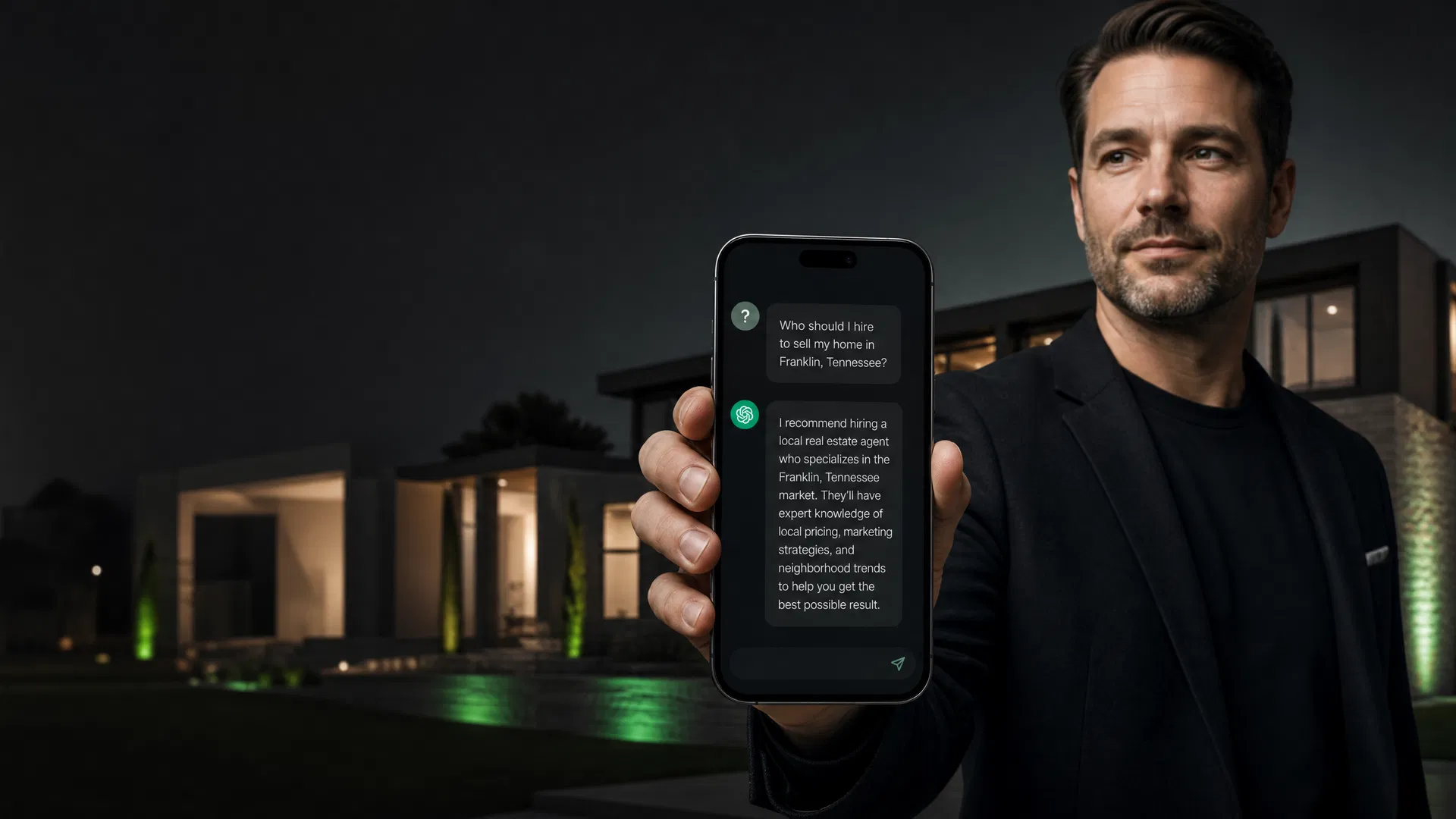
- ✓45% of consumers used AI tools to find local business recommendations in the past year. In 2025 that number was only 6%. AI is now the third most-used discovery channel for local businesses.
- ✓Only 1.2% of businesses get recommended on ChatGPT. You can dominate Google and be completely invisible when someone asks AI for a recommendation.
- ✓AI doesn't pick the best agent. It picks the one it understands. Brands mentioned positively across at least four different platforms were 2.8x more likely to appear in ChatGPT responses.
- ✓Brand mentions are 3x more predictive of AI visibility than backlink profiles. Third-party proof is no longer a nice-to-have. It's how AI decides who to trust.
- ✓The 6-step playbook: pick your positioning, fix your Google Business Profile, upgrade your review process, fix your YouTube library, get third-party mentions, and use social to reinforce the same message.
A buyer in Franklin, Tennessee opens ChatGPT and types:
"Who should I hire to sell my home?"
AI scans the internet.
It reads reviews. Watches videos. Checks forums. Analyzes patterns.
Then it answers.
Sometimes it mentions your name.
Most of the time? It doesn't.
And you never even know the conversation happened.
That's the new reality of real estate marketing in 2026.
Your next client might be asking AI about you right now. And if AI can't find enough proof to trust you, someone else gets the call.
Your Buyers Are Already Asking AI (Whether You Like It Or Not)
Here's what changed in the last 12 months:
45% of consumers used AI tools to find local business recommendations in the past year.
In 2025? That number was only 6%.
AI is now the third most-used discovery channel for local businesses, right behind Google and Facebook.
The biggest users? 30-44 year olds. 64% of them are asking AI for local recommendations.
That's not teenagers asking AI to write their homework.
That's your exact buyer demographic asking who to trust with their $500,000 decision.
They're asking ChatGPT who knows their neighborhood. They're asking Gemini who's best for first-time buyers. They're asking Perplexity which agent actually uses video marketing. They're using Google AI Overviews to build their shortlist.
And here's the uncomfortable question:
When they ask about you, what does AI say?
Being Visible On Google Doesn't Mean AI Can See You
Most agents assume: "I'm on page one of Google. I'm in the map pack. I'm good."
Turns out that's not how this works.
AI search is 30 times more selective than traditional Google search.
The numbers are brutal:
- Only 1.2% of businesses get recommended on ChatGPT
- Only 7.4% on Perplexity
- Only 11% on Gemini
- Meanwhile, those same businesses show up in Google's local 3-pack 35.9% of the time.
You can dominate Google and be completely invisible when someone asks AI for a recommendation.
Traditional SEO gets you ranked. Answer engine optimization gets you recommended.
And right now, most realtors aren't even playing the second game.
AI Doesn't Pick The Best Agent. It Picks The One It Understands
Here's what most agents get wrong:
They think AI is looking for the most experienced agent. The one with the most sales. The biggest team. The fanciest brand.
That's not how AI works.
AI doesn't create authority. It aggregates it.
When someone asks AI for a recommendation, it scans the internet asking:
- Do multiple trusted sources say the same thing about this agent?
- Is their name consistently connected to the same city, service, and outcome?
- Do reviews, videos, directories, forums, and articles tell a consistent story?
- Do third parties confirm what the agent claims about themselves?
Research from Clearscope found that brands mentioned positively across at least four different platforms were 2.8x more likely to appear in ChatGPT responses than brands only mentioned on their own websites.
Your website matters.
But your website alone can't create the consensus AI needs to feel confident recommending you.
AI wants corroboration.
It wants to see other people saying what you're saying about yourself.
That's why the clearest agent wins, not always the best one.
What AI Actually Looks For (And Why Most Agents Don't Have It)
AI treats brands like evidence in a court case.
One witness? That's just your opinion.
Four independent witnesses saying the same thing? Now we're getting somewhere.
For realtors, that means AI is looking for your name, city, service, and expertise mentioned across multiple trusted sources:
- Google Business Profile with detailed reviews
- YouTube videos with structured descriptions
- Reddit or community forum mentions
- Local news or blog features
- Chamber of Commerce directory
- Podcast appearances
- Neighborhood guides
- Real estate partner articles
- Industry directories
Once your story shows up across four or more credible places, AI starts building confidence.
That's when visibility shifts.
Here's What Consensus Actually Looks Like:
Your website says you help Franklin TN homeowners sell with better preparation, pricing, video marketing, and negotiation.
Your Google reviews say clients valued your pricing, communication, video, and negotiation in Franklin.
Your YouTube videos explain how Franklin sellers can prepare, price, market, and negotiate better.
A Reddit thread mentions you as a strong local listing agent.
A local blog quotes you about the Franklin housing market.
Your Google Business Profile categories match the same positioning.
Now AI sees a pattern.
Pattern creates confidence. Confidence creates recommendations.
Brand Mentions Beat Backlinks (And Most Agents Are Still Playing The Old Game)
For 20 years, SEO was all about backlinks.
Get more sites linking to you. Build domain authority. Climb the rankings.
Backlinks still matter for Google.
But AI plays by different rules.
Ahrefs found that brand mentions are 3x more predictive of AI visibility than backlink profiles.
AirOps research showed 85% of brand mentions came from third-party pages, not the agent's own site.
That means someone mentioning your name, city, and expertise on a trusted page helps AI understand you, even without linking to your website.
For realtors, this changes everything:
Your website matters. Your social profiles matter. Your bio matters.
But AI also wants to know what everyone else says about you.
Third-party proof isn't a nice-to-have anymore.
It's how AI decides who to trust.
Your Reviews Are Probably Worthless To AI (Here's How To Fix That)
Most realtors ask for reviews the same way:
"Can you leave me a review?"
The client writes:
"Great job! Highly recommend. Sarah was amazing!"
That feels good.
But AI learns almost nothing from it.
AI extracts meaning from review text. It looks for names, cities, services, problems, results, property types, client situations.
Generic praise doesn't give AI anything to work with.
Weak Review:
"Sarah was great. Highly recommend."
Strong Review:
"Sarah Mitchell helped us sell our home in Franklin, Tennessee with a strong pricing strategy, video marketing, and clear communication from listing to closing."
That second review gives AI usable proof.
It connects:
- Name
- Location
- Service
- Outcome
- Experience
Your Review Responses Matter Too
Weak response:
"Thank you so much!"
Strong response:
"Thank you for trusting us with your Franklin home sale. We loved helping you prepare, price, market, and negotiate so you could move into your next home with confidence."
That response adds local and service context.
It helps future prospects understand what you do. And it helps AI connect the dots.
Reviews Also Create A Confidence Threshold
AI doesn't treat reviews like old Google rankings.
It uses them as a confidence filter.
Locations recommended by ChatGPT average around 4.3 stars.
Locations near 3.4 stars with review response rates below 5%? Effectively invisible.
Your Google Business Profile isn't just social proof anymore.

More Closings. Fewer Financing Surprises.
Tired of deals dying because your buyer's lender dropped the ball? Keith is the mortgage partner listing agents call when they need deals protected, difficult files approved, and buyers who show up pre-qualified.
It's part of your AI visibility system.
YouTube Might Be Your Biggest Opportunity (And You're Probably Ignoring It)
YouTube is one of the most powerful AI visibility tools realtors have access to.
And most agents are completely underutilizing it.
YouTube is cited 200x more than any other video platform across ChatGPT, Gemini, and Perplexity.
It's the most-cited domain in AI search overall.
YouTube appears in 29.5% of Google AI Overviews.
And this isn't just Google playing favorites.
ChatGPT, Perplexity, and Gemini (platforms with no reason to favor Google) still cite YouTube almost exclusively when they reference video content.
Why?
Because YouTube videos come packaged with structured data AI can easily read:
- Title
- Description
- Transcript
- Chapters
- Timestamps
- Comments
- Channel context
AI doesn't watch your video like a person.
It reads the data around the video.
That means your YouTube description matters way more than you think.
Descriptions Matter More Than Views
Here's the part that should wake you up:
Description length has a 0.31 correlation with AI citation frequency.
Meanwhile, views, likes, and subscriber count? Near zero correlation.
A small realtor channel with detailed descriptions can outperform a massive channel with lazy metadata.
You don't need to become a YouTube celebrity.
You just need your videos to be structured, clear, and easy for AI to cite.
What A Good YouTube Video Looks Like To AI
Each important video should have:
- A question-based title
- A direct answer in the first two lines of the description
- At least a 200-word description (500+ for your best videos)
- Natural local keywords
- Timestamped chapters
- An accurate transcript
- A clear next step
Weak title:
"June Market Update"
Strong title:
"Is The Franklin TN Housing Market Slowing Down In 2026?"
Weak description:
"Here is my June market update."
Strong description:
"This video explains what Franklin TN buyers and sellers need to know about the 2026 housing market. We cover inventory, pricing, buyer demand, seller expectations, negotiation, and what to watch before making a move."
The second version gives AI something to cite.
The first version doesn't.
Social Media: Support, Not Strategy
Instagram and Facebook still matter for realtors.
But probably not in the way you think.
Starting July 10, 2025, public posts on Instagram and Facebook became eligible to appear in Google search results.
Geotags help search engines understand where you operate.
But here's the catch:
AI platforms aren't heavily citing Instagram and Facebook posts as primary sources for local business recommendations.
Facebook blocks many AI crawlers. Instagram isn't showing up as a major citation source across the big platforms.
So don't build your entire AI strategy around clever captions.
Use social media as support, not the foundation.
Weak caption:
"Another one sold! So happy for my sellers"
Strong caption:
"This Franklin TN seller needed more than photos and the MLS. We built the listing around the right buyer, local positioning, video, and a follow-up plan designed to create stronger showing activity."
That second caption helps humans understand what you do. It helps Google understand the post. It gives clients and third parties better language to repeat when they talk about you.
But social should point people toward your stronger proof assets:
- YouTube videos
- Blog posts
- Google reviews
- Local guides
- Podcast episodes
- Google Business Profile
- Third-party mentions
Social supports the proof system.
It doesn't replace it.
Your 6-Step AI Visibility Playbook
Here's how to actually do this.
Step 1: Pick Your Positioning
Be specific about who you help and how.
Example: "I help Franklin TN homeowners sell with stronger pricing, preparation, video marketing, local positioning, and negotiation."
Don't try to be everything to everyone.
AI needs a clear, consistent pattern to work with.
Step 2: Fix Your Google Business Profile
Make sure everything reinforces the same story:
- Update categories
- Update services
- Update description
- Add photos
- Add posts
- Respond to every review with context
This isn't busywork. It's building the foundation AI uses to understand you.
Step 3: Upgrade Your Review Process
Stop asking for generic reviews.
Send this instead:
"Would you mind leaving me a Google review? It helps future buyers and sellers understand what we worked on together. If helpful, mention the area, what you were trying to accomplish, and what part of the process helped you most."
That simple shift gets you reviews AI can actually use.
Step 4: Fix Your YouTube Library
Start with your best 10 videos.
- Rewrite the titles to be question-based
- Rewrite the descriptions with structure and context
- Add chapters
- Verify transcripts are accurate
- Add local keywords naturally
- Put the answer in the first two lines
Before you record more videos, fix the assets you already own.
Step 5: Get Third-Party Mentions
Do one per week:
- Ask a past client to mention you in a relevant Reddit or Facebook thread
- Get listed on your local Chamber of Commerce page
- Pitch a local podcast
- Offer a quote to a local blog or news site
- Write a guest article for a local business partner
- Create a neighborhood guide someone would want to reference
- Ask a business partner to include you on their local resource page
This is how you move from owned content to consensus.
One mention per week = 52 new proof points per year.
That adds up fast.
Step 6: Use Social Media To Reinforce The Same Message
Your social content should repeat your core positioning:
- Same name
- Same city
- Same service
- Same expertise
- Same outcomes
Consistency beats creativity when it comes to AI visibility.
The Bottom Line
AI search is real.
It's growing fast.
And it's way more selective than Google.
Most realtors won't show up when buyers and sellers ask AI for recommendations.
Not because they're bad agents.
Because AI doesn't have enough clear, consistent proof to trust them.
The agents who win in this new world will build consensus across multiple trusted sources:
- Detailed reviews that mention specifics
- Strong review responses that add context
- An accurate, complete Google Business Profile
- YouTube videos with clear, structured descriptions
- Third-party mentions from real sources
- Local content that reinforces expertise
- Social media that supports the bigger proof system
You don't need to become a tech expert.
You just need to become easier for AI to understand.
Name + city + service + expertise.
Repeated across trusted sources.
Consistent. Clear. Corroborated.
That's the playbook.
When a buyer or seller asks AI who to hire, the answer won't come from luck.
It will come from proof.
Start building that proof now, before your competition figures this out.
Frequently Asked Questions
How does AI decide which realtor to recommend?
AI aggregates proof from multiple trusted sources. It looks for your name, city, service, and expertise mentioned consistently across Google reviews, YouTube videos, directories, forums, local blogs, and partner pages. Brands mentioned positively across at least four different platforms were 2.8x more likely to appear in ChatGPT responses than brands only mentioned on their own websites.
What percentage of businesses get recommended by ChatGPT?
Only 1.2% of businesses get recommended on ChatGPT. By comparison, 7.4% show up on Perplexity, 11% on Gemini, and 35.9% in Google's local 3-pack. You can rank on page one of Google and still be completely invisible when someone asks AI for a recommendation.
How should realtors ask for Google reviews to improve AI visibility?
Stop asking for generic reviews. Instead, prompt clients to mention the area, what they were trying to accomplish, and what part of the process helped them most. A review that says 'Sarah Mitchell helped us sell our home in Franklin, Tennessee with a strong pricing strategy, video marketing, and clear communication from listing to closing' gives AI usable proof. Generic praise like 'Great job! Highly recommend' gives AI almost nothing to work with.
Why is YouTube so important for realtor AI visibility?
YouTube is cited 200 times more than any other video platform across ChatGPT, Gemini, and Perplexity. It appears in 29.5% of Google AI Overviews. Description length has a 0.31 correlation with AI citation frequency, while views, likes, and subscriber count have near zero correlation. A small channel with detailed descriptions can outperform a massive channel with lazy metadata.
What is the difference between traditional SEO and answer engine optimization?
Traditional SEO gets you ranked in Google search results. Answer engine optimization gets you recommended when someone asks an AI tool for a local business recommendation. AI search is 30 times more selective than traditional Google search. The strategies overlap but are not the same. AI prioritizes consistent brand mentions across multiple trusted third-party sources, not just backlinks and on-page optimization.

Keith has helped 2,980+ families close on homes across 12+ markets over 24+ years, with $310M+ in closed loans. He specializes in difficult files, listing-agent partnerships, and the kind of complex deals most lenders turn away.
He writes the Realtor Money Alerts to give agents the plays, programs, and systems that protect deals and generate more closings.
Want plays like this every week?
Drop your email and I'll send you the next one first.
Let's Talk About Your Business
If you want to see if we can get more buyers and sellers for you, a 15-minute call is all it takes. No pitch. No pressure. Just a real conversation about your business.
Keith works with a small number of agents in each market. If there is a fit, you will know by the end of the call.
"Keith helped us get an offer on a $2.8 million dollar listing in Arrington, TN with a custom funnel. Incredible results."
"Keith has been instrumental in the growth of our listing leads coming in. He is a true partner."
We help you grow your business and get you more clients · Keith Goeringer NMLS #488023 · No obligation