
- ✓The more space you have, the more options you have.
- ✓You're not responsible for staying inside the house to protect the seller's property when your own safety is at risk.
- ✓The buddy system starts with the first sign you put in the ground and ends when the last sign is back in the car.
- ✓The alarm doesn't replace calling 911 or having a buddy. Your vehicle might be too far away for the remote to work, and nobody is guaranteed to respond.
I go to a lot of open houses, but not for the reason you might think.
Many times, I go to protect the Realtor.
It's a dangerous situation, and things have unfortunately happened.
Sure, I'm a mortgage lender. I enjoy meeting potential homebuyers and helping Realtors with their business.
But I've been attending open houses for years with another purpose in mind.
I don't like the thought of a Realtor sitting alone in an empty house, inviting complete strangers through the front door, without anyone else there to help if something goes wrong.
Especially women. But I feel the same way about male Realtors.
Think about what you're doing.
You're advertising an address, publishing the exact hours you'll be inside, and inviting complete strangers into a property.
Some of these houses are enormous. Multiple floors, basements, garages, and rooms where someone might become isolated.
And plenty of Realtors do this completely alone.
I've worked with Realtors for more than two decades. I've been to countless open houses, and I've personally witnessed visitors whose behavior made me uncomfortable.
I've also spent three years studying mixed martial arts.
Between those two experiences, I've developed some strong opinions about Realtor safety.
And I think we need to have this conversation.
Why My Martial Arts Training Changed How I Look at Safety
I earned a red-black belt through three years of mixed martial arts training.
We studied karate, jujitsu, Aikido, Krav Maga, and various military-inspired self-protection techniques.
We trained three times a week.
I spent thousands of repetitions kicking bags, learning defensive movements, practicing escapes, and working through different physical situations.
But the most valuable thing I learned wasn't how to fight.
It was how to stay calm when someone is threatening you.
During our belt testing, instructors deliberately put us into stressful situations.
We might be grabbed unexpectedly in the dark. Sometimes multiple people would attack during an exercise.
Your adrenaline goes through the roof.
You have to learn to recognize what's happening, maintain control of your breathing, and respond rather than panic.
Of course, no amount of training guarantees how you'll react during a real attack. Freezing is a natural survival response.
But repeatedly practicing under controlled stress helps you build familiarity with situations you hope never to encounter.
One of the biggest lessons I learned was simple.
The more space you have, the more options you have.
If somebody moves too close, create distance.
If someone attempts to corner you, look for an exit.
If someone grabs you, having practiced escape techniques with a qualified instructor gives you a better foundation for responding.
I learned wrist-release techniques, responses to different grabs, and ways to regain balance when physically restrained.
These aren't things I would expect the average Realtor to know without training.
And I think every Realtor should learn some of them.
Not because I want anyone getting into a fight.
Quite the opposite.
The whole purpose of learning self-defense is preparing for a situation you hope never experience.
A Visitor Who Made Both of Us Uncomfortable
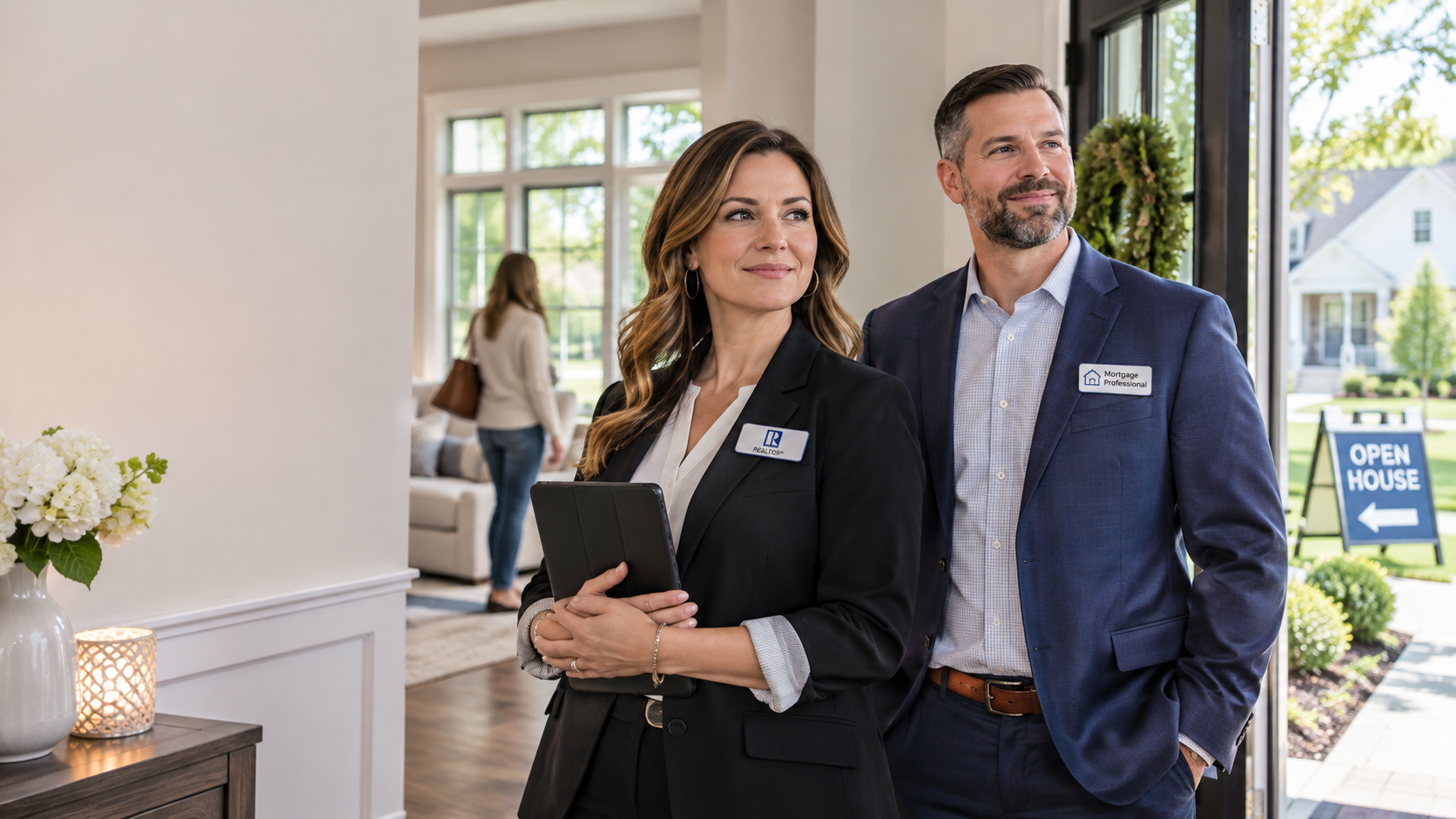
I remember attending an open house with a female Realtor when a man walked through the door.
Something about his behavior seemed unusual.
He wasn't showing much interest in the property. He was asking the Realtor strange questions, and he was acting overly familiar toward her.
I was standing beside her, watching the interaction.
I started engaging him in conversation.
I asked questions I would normally ask a potential buyer, but I was more direct than usual.
When are you looking to purchase?
What makes you interested in buying a house?
What are you looking for?
I wasn't trying to sell him a mortgage.
I wanted to understand why he was there.
He became uncomfortable with the questions and didn't have much to say. Eventually, he explained he was looking around and wasn't actively searching for a home.
Now, none of this proves he had bad intentions.
People attend open houses for all kinds of reasons. Neighbors visit. Curious people look around. Some buyers haven't figured out their plans.
But his behavior toward the Realtor concerned me.
After he left, the Realtor and I discussed the interaction.
She told me she'd felt uneasy, too, and was glad I was there.
I don't know what would have happened if she'd been alone.
Perhaps nothing.
But I was glad she didn't have to handle an uncomfortable situation by herself.
That's the value I see in the buddy system.
This Isn't Only a Concern for Women
The National Association of Realtors published its 2024 Member Safety Residential Report.
The findings deserve attention.
- 25% of female respondents reported situations involving fear for personal safety or the security of personal information.
- 12% of male respondents reported the same.
- 17% of residential respondents reported feeling unsafe while hosting an open house alone.
- Among respondents who reported a safety concern, 34% identified an open house as a setting where they felt unsafe.
The report also found 96% had not been victims of crime while working as real estate professionals.
These numbers don't mean every open house is dangerous. They also don't measure the effectiveness of having a second person present.
But they show safety concerns are real for both men and women.
And we know terrible incidents have occurred.
In April 2011, Iowa Realtor Ashley Okland was murdered while working at a model townhome. Nearly 15 years later, in March 2026, authorities arrested and charged a suspect. The criminal case was still proceeding as of the reporting reviewed for this article.
Her death is a painful reminder of why the real estate industry needs to take agent safety seriously.
I don't think you should live in fear.
I think you should have a plan.
Before Anyone Walks Through the Door, Learn the House
Whenever I arrive at an open house, one of my first priorities is understanding the property.
Where are the exits?
What does the layout look like?
Are there places someone might become isolated?
Does the back door lead somewhere safe, or is the yard enclosed by a fence?
What about the basement? The garage? The upstairs bedrooms?
You need to understand the property before people start coming through.
This matters in Middle Tennessee.
A large home in Brentwood or Franklin might have multiple staircases, a finished basement, and rooms far from the entrance.
A vacant property in Columbia or rural Maury County might have limited cell coverage or fewer nearby people.
Each property presents different considerations.
I also pay attention to the visitors.
How do they interact with the Realtor?
Are they respecting personal boundaries?
Are they trying to separate the Realtor from other people?
Do they block doorways or ignore requests to keep their distance?
Someone's appearance, unfamiliarity with the neighborhood, or lack of knowledge about buying a home isn't evidence of danger.
Behavior is what deserves attention.
And if you're uncomfortable, you don't have to wait for proof of someone's intentions before taking precautions.
What Should You Do When Someone Makes You Uncomfortable?
My preference is simple.
Leave the situation.
If a visitor starts making inappropriate comments, invading your personal space, or acting aggressively, start moving toward a safe exit.
You don't have to confront them.
You don't have to explain why you're uncomfortable.
You might say you need to step outside to handle an urgent call or meet someone.
Then leave.
Find other people or a safe public location. Contact your safety partner, and call 911 if you're facing an immediate threat.
Don't automatically head to your car if someone is following you or blocking your path. The priority is reaching safety, not reaching the vehicle.
Here's something I feel strongly about.
You're not responsible for staying inside the house to protect the seller's property when your own safety is at risk.
The open house will wait.
The signs will wait.
The brochures will wait.
Get yourself somewhere safe.
One Safety Tool You Already Have Might Be on Your Keychain
Here's something simple I think every Realtor should know.
Your car keys might provide another way to attract attention during an emergency.
Many vehicles have a panic button on the key fob.
Press the button, and the horn starts sounding while the lights flash.
Think about an open house where someone makes you uncomfortable.
Your vehicle is parked out front, and you need to get attention.
If your key fob is within range, activating your car alarm might alert someone outside.
A neighbor might look out the window. Your open-house partner might recognize something is wrong.
And someone threatening you might decide they don't want the attention.
It's such a simple idea, but many people never think about using their car alarm for personal safety.
The National Association of Realtors even includes this recommendation in its safety training materials.
There are a few things I'd recommend doing before your next open house.
First, find out whether your vehicle has a panic alarm and how to activate it.
Second, test the operating range under normal conditions so you understand where the alarm works. Coordinate any test so you don't create an unnecessary disturbance.
Third, keep your keys accessible. Don't leave them sitting on a counter in the kitchen or buried at the bottom of your purse.
If you need to activate the alarm, don't stand around waiting to see who responds.
Get somewhere safe and contact emergency services when needed.
The alarm doesn't replace calling 911 or having a buddy. Your vehicle might be too far away for the remote to work, and nobody is guaranteed to respond.
But it's another option worth knowing about.
And preparation is about having options.
Should Realtors Carry Something for Personal Protection?
I'm a believer in being prepared.
When I attend open houses, I often have a heavy-duty flashlight with me.
It's useful when inspecting dark areas of a property, checking exits, or walking to your vehicle after sunset.
There are also other tools worth considering.
Personal alarms are inexpensive and designed to attract attention.
Your phone has emergency features, including location sharing and SOS functions.
Pepper spray intended for personal defense is another option. Anyone carrying spray should understand local laws, safe handling, manufacturer directions, and the risk of accidental exposure.
I've also looked into TASER devices and CO2-powered defensive launchers.
These are often described as less-lethal weapons, but that doesn't mean harmless. Serious injuries remain possible. Their effectiveness depends on the circumstances, and proper training matters.
More Closings. Fewer Financing Surprises.
Tired of deals dying because your buyer's lender dropped the ball? Keith is the mortgage partner listing agents call when they need deals protected, difficult files approved, and buyers who show up pre-qualified.
I would also distinguish bear spray from ordinary defensive pepper spray.
Bear spray is designed for deterring bears. EPA-registered bear sprays have specific labeled uses, and spraying chemicals inside an occupied home creates risks for everyone nearby.
I wouldn't recommend substituting bear spray for a purpose-made personal safety product at an open house.
Whatever you choose, understand what you're carrying, what the law allows, and the limitations of the equipment.
What About Responsible Gun Ownership and Concealed Carry?
Let's talk about something else.
Firearms.
Some of us are responsible gun owners. Others choose not to own a firearm.
That's a personal choice, and I respect both.
But I believe responsible gun ownership involves much more than purchasing a firearm.
You need proper training.
You need to understand safe handling, storage, and the laws governing when a firearm is legally permitted and when defensive force is justified.
And I would encourage anyone who carries to seek training beyond basic target practice.
There are courses where you learn how to respond under pressure, make decisions during stressful situations, and recognize when drawing or using a firearm would make things worse.
Those are important skills.
Here's something else I believe.
There's a reason it's called concealed carry.
Strangers don't need to know whether you have a firearm.
You don't need to announce how you protect yourself, and you shouldn't make assumptions about whether another person is armed.
Discretion matters.
Of course, this doesn't change your legal obligations. Tennessee has specific rules governing handgun carry, including restrictions on certain properties and locations. Any Realtor considering a firearm needs to understand the applicable laws, property restrictions, and brokerage policies.
And carrying a firearm doesn't replace awareness, self-defense training, or the buddy system.
In fact, one of the biggest lessons I took from martial arts applies here.
The best outcome is never having to use a weapon.
I trained with scenarios involving knives and firearms. Those experiences taught me how dangerous a physical confrontation becomes when a weapon is involved.
Even with my training, I would never want to confront someone carrying a knife.
My goal would be avoiding the confrontation and getting to safety.
That's the mindset I believe responsible firearm owners should have, too.
You prepare because you hope the situation never happens.
Not because you're looking for an opportunity to use what you're carrying.
Why I Think Every Brokerage Should Offer Self-Defense Training
One of the things I wish more real estate brokerages would do is provide ongoing self-defense education.
Not a single presentation once a year.
Real training.
At least quarterly, with opportunities for agents to continue practicing between classes.
When I trained in mixed martial arts, we attended three times a week.
I'm not suggesting every Realtor needs to become a martial artist.
But there are practical skills worth learning.
How to maintain distance.
How to recognize threatening behavior without stereotyping people.
How to respond when someone grabs your wrist.
How to protect your balance.
How to escape physical restraint and move toward safety.
And perhaps most importantly, how to practice staying composed under stress.
An introductory self-defense video offers a starting point for learning terminology and understanding techniques. But hands-on training with a qualified instructor is where you learn proper execution, receive corrections, and practice safely.
The NAR's 2024 report found 41% of residential respondents had participated in a self-defense class.
I'd like to see more Realtor associations and brokerages provide opportunities for ongoing education.
Realtors spend money learning how to negotiate contracts, generate leads, and market listings.
Protecting yourself deserves a place on the training calendar, too.
The Buddy System Starts Before the Open House Opens
Here's something I want mortgage lenders to hear.
I see lenders show up at open houses 20 minutes after the event starts.
They talk to a few buyers, grab a bottle of water, and leave.
I think that's a cop-out.
You've missed a big part of the work.
Getting an open house ready involves putting signs out, turning on lights, preparing refreshments, organizing the property, and making sure everything is ready for visitors.
And when the open house ends, someone has to take everything down and secure the property.
If you're truly supporting your Realtor partner, show up early.
Help with the work.
Stay for the entire event.
Help clean up.
The buddy system starts with the first sign you put in the ground and ends when the last sign is back in the car.
Why?
Because the Realtor deserves support during setup and cleanup, too.
The National Association of Realtors specifically recommends working with another person at an open house and arranging assistance during closing.
A buddy doesn't eliminate danger. But two people have more opportunities to notice a problem, communicate, and seek help.
And there's another benefit.
I believe open houses work better with two professionals.
A Realtor answers questions about the property and the market. A lender answers financing questions.
Visitors have two knowledgeable people available instead of one person trying to manage everything.
I've found those conversations help build relationships.
You might even meet a future client.
But to me, the relationship-building opportunity comes second.
The real priority is making sure your partner is safe.
What If Nobody Is Available to Attend With You?
I have strong feelings about this.
If I'm making the decision, I don't want the Realtor hosting the open house alone.
I recognize some locations present different circumstances.
A busy subdivision with neighbors nearby and someone available to check on you is different from a vacant property on an isolated road.
But neither location eliminates the risk.
If you absolutely must work alone, take additional precautions.
Arrange scheduled check-ins with someone who knows your exact location.
Share your location when appropriate.
Keep your phone charged and accessible.
Keep your keys with you and know how to activate your vehicle's panic alarm.
Know your exits.
Use a consistent visitor registration process.
Arrange for someone to help with closing.
And have a specific plan for leaving if something feels wrong.
But I'd still encourage you to find a partner or reschedule.
You can host the open house another day.
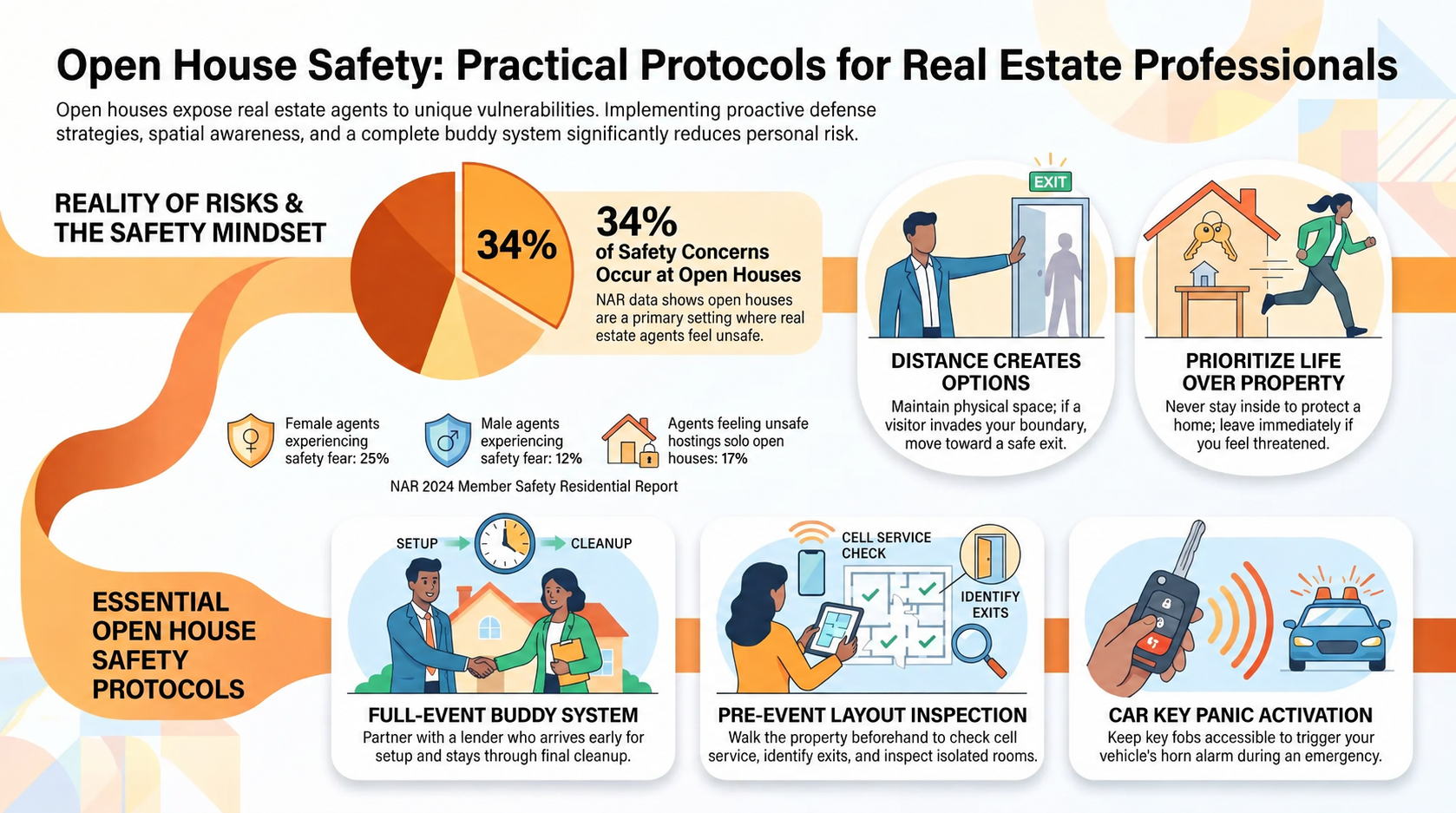
Open house safety protocols: buddy system, exits, personal space, and accessible car keys
A Safety Checklist Before Your Next Open House
Every Realtor should have a repeatable procedure.
Before the event:
- Arrange a co-host or buddy whenever possible.
- Tell a trusted contact the address and scheduled hours.
- Check phone service and emergency contact settings.
- Walk the property and identify safe exits.
- Check the garage, basement, backyard, and other isolated areas before visitors arrive.
- Confirm seller valuables, medications, and personal information are secured.
- Agree with your buddy on a discreet signal meaning you need assistance.
- Know how your car's panic alarm works and whether you have access to it from the property.
- Check any personal safety equipment you carry and understand how to use it legally and safely.
During the event:
- Follow consistent visitor registration procedures.
- Keep your phone and keys accessible.
- Avoid becoming isolated in rooms with limited exits.
- Respect your instincts when behavior crosses boundaries.
- Keep your buddy informed if you're uncomfortable.
- Leave and get help when you feel threatened.
After the event:
- Confirm visitors have left.
- Secure the property with your partner when safe.
- Don't enter an area if you suspect someone is hiding inside.
- Collect signs and materials together.
- Tell your check-in contact you've finished safely.
Make the process routine. You shouldn't have to invent a safety plan during an emergency.
"I've Been Doing Open Houses Alone for 20 Years"
I've heard variations of this argument.
I've been doing open houses for years.
I've never had an issue.
I know what I'm doing.
And I'm glad those Realtors have never experienced a serious problem.
I hope they never do.
But experience doesn't make you immune to someone else's bad decisions.
You control your preparation.
You don't control who walks through the front door.
I've studied martial arts. I've practiced defending myself under pressure. I've learned techniques for dealing with physical attacks.
And I still believe avoiding an altercation is the smartest outcome.
Preparation isn't about expecting something bad to happen.
It's about being ready if something does.
That's why I keep coming back to the buddy system.
A Personal Request to Realtors and Mortgage Lenders
I've been going to open houses partly to help protect Realtors for several years.
I can't attend everyone's events.
But I would love to see more lenders, Realtors, and brokerage owners take personal responsibility for looking out for one another.
If you're a lender, offer to attend an open house.
And I don't mean showing up late to talk about mortgages.
Get there early. Help set up. Stay through cleanup.
If you're a Realtor, find someone you trust to attend with you.
Male or female, the recommendation is the same.
If you manage a brokerage, consider establishing a buddy system and arranging quarterly self-defense training for your agents.
And whether you choose to carry personal protection equipment or not, take the time to learn how to recognize danger, create distance, and leave safely.
You don't need a dangerous encounter to justify a safety procedure.
You need preparation and people willing to look out for each other.
I've spent years helping Realtors build their businesses, generate referrals, and improve their marketing.
But I also care about making sure the people I work with get home safely.
And sometimes, when you see me at an open house, that's the main reason I'm there.
Not to sell a mortgage.
To make sure the Realtor isn't alone.
Keith Goeringer
Realtor Safety Resources
National Association of Realtors Safety Program
NAR 2024 Member Safety Residential Report
NAR Safety Training Manual, Including Car Alarm and Firearm Safety Guidance
Tennessee Department of Safety: Handgun Carry Permits and Laws

Keith has helped 2,980+ families close on homes across 12+ markets over 24+ years, with $310M+ in closed loans. He specializes in difficult files, listing-agent partnerships, and the kind of complex deals most lenders turn away.
He writes the Realtor Money Alerts to give agents the plays, programs, and systems that protect deals and generate more closings.
Want plays like this every week?
Drop your email and I'll send you the next one first.
Let's Talk About Your Business
If you want to see if we can get more buyers and sellers for you, a 15-minute call is all it takes. No pitch. No pressure. Just a real conversation about your business.
Keith works with a small number of agents in each market. If there is a fit, you will know by the end of the call.
"Keith helped us get an offer on a $2.8 million dollar listing in Arrington, TN with a custom funnel. Incredible results."
"Keith has been instrumental in the growth of our listing leads coming in. He is a true partner."
We help you grow your business and get you more clients · Keith Goeringer NMLS #488023 · No obligation