
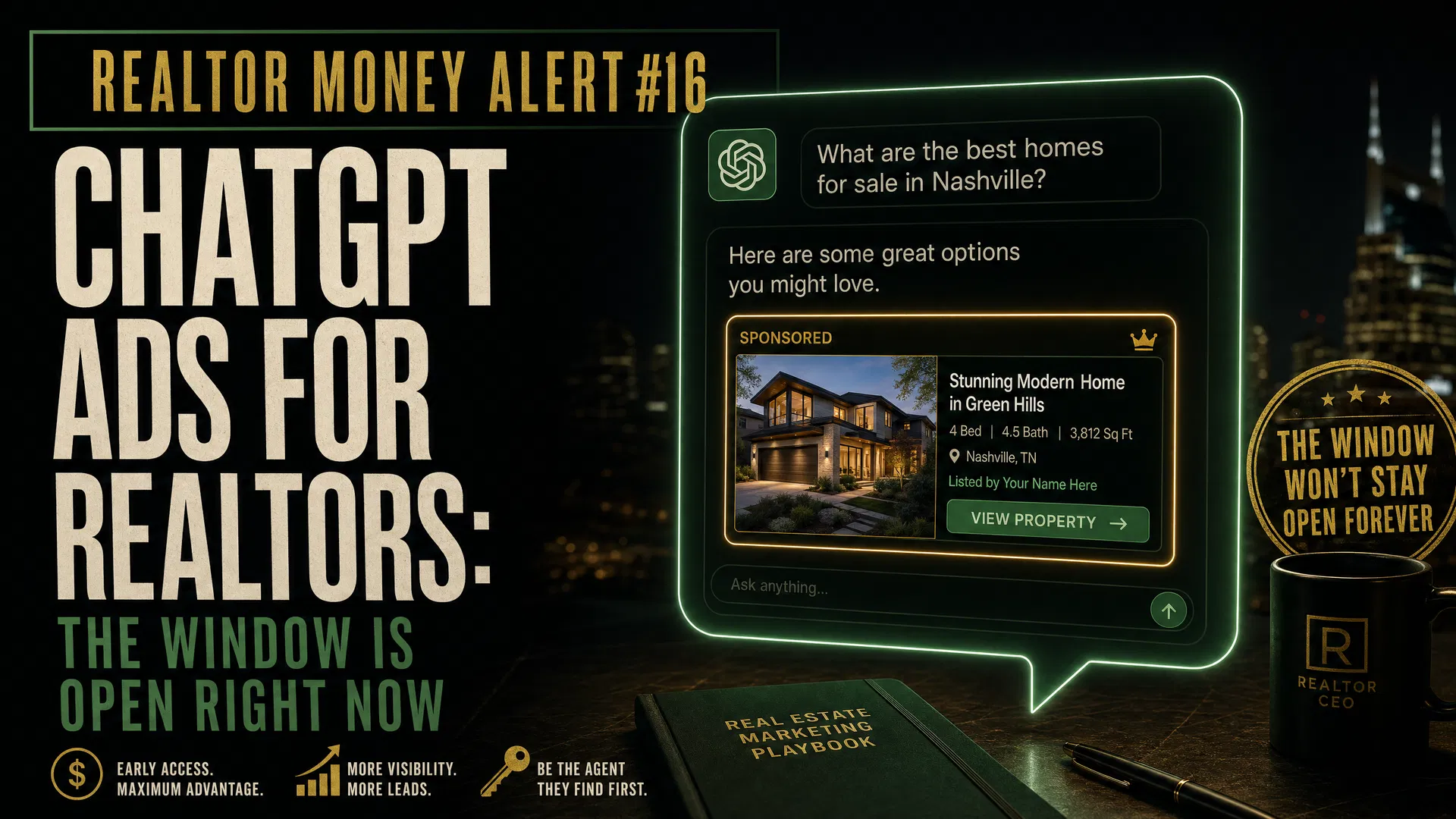
- ✓ChatGPT Ads are live right now at ads.openai.com, a self-serve ad platform where your business appears inside ChatGPT conversations as people work through real buying and selling decisions.
- ✓Early data shows ChatGPT ads are performing 256% better than Meta and 38% cheaper per conversion than Google, and almost no realtors are running them yet.
- ✓The ad appears as a sponsored card alongside ChatGPT's answer, reaching Free and Go tier users, the vast majority of ChatGPT's hundreds of millions of users.
- ✓Approval takes several days, so apply now even if you're not ready to run ads. The account setup clock starts when you submit, not when you launch.
- ✓One campaign, one audience, one landing page, one clear next step. That's how you test this without chaos.
I've watched this exact pattern play out four times in my career.
A new ad platform opens. A small group moves fast. Everybody else waits to see if it's going to work. Two years later, the people who waited are complaining that the platform is too crowded, too expensive, and doesn't work anymore.
I saw it with Google PPC. I saw it with Facebook ads. I watched Zillow Premier Agent go from "gold in your backyard" to "40% of gross commission." I watched Google Local Service Ads go from agents whispering "don't tell anyone about this" to the whole market piling in and the results dropping.
Every single time, the early bird got the worm.
ChatGPT just opened that window again.
What ChatGPT Ads Actually Are
OpenAI is rolling out a self-serve ads manager at <a href="https://ads.openai.com" target="_blank" rel="noopener noreferrer" style="color:#1a4a24;text-decoration:underline;">ads.openai.com</a> for US businesses. Your ad appears as a sponsored card inside the ChatGPT interface, directly above or below the AI's answer to a user's question.
It is not a pop-up. It is not an interruption. It is a clearly labeled sponsored result that appears at the exact moment someone is working through a decision.
Here's what makes this different from every other platform you've already used:
Google is keyword-based. Someone types "Nashville realtor" and you show up. High intent, but they're already in search mode, already comparing five agents.
Facebook and Instagram are interruption-based. Someone is scrolling through dog videos and your ad cuts in. Low intent. You're fighting for attention against everything else on their screen.
Zillow is browsing-based. They're window shopping listings and your face pops up. Medium intent, but they're not ready to talk yet.
ChatGPT is conversation-based. Someone is actually working through a decision. Back and forth, like a therapist. And your business appears in that moment when they're thinking out loud about one of the biggest financial decisions of their life.
Think about what people ask ChatGPT before they ever call an agent:
- "Should I sell now or wait until spring?"
- "Is it smarter to buy first or sell first?"
- "How do I pick a good agent in Nashville who actually knows what they're doing?"
- "What do I need to know before buying my first home?"
- "Is Nashville still a smart place to buy right now?"
Those are not casual questions. Those are buying and selling signals. If someone said that to you on the street, you would stop and give them your best answer. Now, for the first time, you can show up inside those conversations as a sponsored result.
The Numbers Are Hard to Ignore
Early performance data from the platform is already turning heads. Digital marketing analyst Eric Siu reported that ChatGPT ads are performing 256% better than Meta and 38% cheaper per conversion than Google right now.
Neil Patel noted that affiliate marketers, the people who only spend money when something is profitable, are already buying. That's a signal worth paying attention to.
The reason the numbers look this good right now is simple: almost no one is running ads yet. The competition is nearly zero. That will not last.
Who Sees Your Ads
Not every ChatGPT user sees ads, and that's actually good news for you as an advertiser. The users who see ads are the ones most likely to be in research and decision mode.
Free tier users see ads. ChatGPT Go tier users see ads. Plus, Pro, and Business subscribers do not see ads.
Here's the important part: the free tier alone represents hundreds of millions of users globally. Most people in the world are not paying $20 a month for a ChatGPT subscription. The total addressable market here is enormous, and it skews heavily toward people who are actively researching, not just casually browsing.
Your own ChatGPT subscription level has zero effect on who sees your ads or how your campaigns perform. You can be on any plan and still run ads to Free and Go tier users.
How the Targeting Works (This Is the Good Part)
This is not keyword stuffing. You are not bidding on "best realtor Nashville" a thousand different ways.
Instead, you describe the person in the conversation you want to appear in. OpenAI calls these "context hints." Think of it as a short description of the chat you want your ad to show up beside.
Here's a weak context hint that will not work:
*"People looking to buy or sell real estate."*
Too broad. Too vague. The more specific you are, the better the outcome. That's true with all AI, and it's true here.
Here's a strong context hint for a Nashville listing agent:
*"People in the Nashville area who are thinking about selling their home and want to understand what it's worth, whether now is a good time to list, and how to choose a trustworthy local real estate agent who cares about pricing, preparation, negotiation, and not leaving money on the table."*
That mirrors the actual conversation happening in ChatGPT. It describes the human being, what they're worried about, what keeps them up at night, what they need to move forward.
That's the work that makes this platform pay off.
Three Stages of the Buyer and Seller Journey

More Closings. Fewer Financing Surprises.
Tired of deals dying because your buyer's lender dropped the ball? Keith is the mortgage partner listing agents call when they need deals protected, difficult files approved, and buyers who show up pre-qualified.
Think about where your future client is in the conversation when your ad appears. There are three stages, and each one needs a different message.
Stage 1: Awareness. They're starting to think about moving. Not ready to talk to anyone yet. They're asking things like "Is now a good time to sell?" or "What should I do before listing my house?" They need education and clarity, not pressure.
Stage 2: Consideration. Now they're comparing options. "How do I choose the right real estate agent?" "What makes one agent better than another?" They need proof, reviews, local expertise, and a reason to pick you specifically.
Stage 3: Decision. They're close. "Who should I call first?" "How do I book a consultation?" "What's my home actually worth?" These people need one clear next step, not a generic homepage with 19 buttons on it.
Match your ad and your landing page to the stage. A buyer staring at Zillow all night doesn't need another search box. They need someone to tell them what to avoid, what to prioritize, and how not to screw up a six-figure decision.
What to Send Them to (This Is Where Most Agents Lose)
Most agents pay for the click and then drop people on a page where nothing meaningful happens. That's like buying groceries and leaving them in the trunk.
Before you run a single ad, answer this question: what do I want this person to do?
"Visit my website" is not an answer. Pick one:
- Book a seller strategy call
- Request a home valuation
- Fill out a buyer intake form
- Download a home prep checklist
- Register for a first-time homebuyer workshop
One campaign. One audience. One landing page. One clear next step. That's how you test a new platform without chaos.
Three Campaign Ideas You Can Steal Right Now
Campaign 1: Homeowners thinking about selling. Offer: "Should I sell now or wait?" 15-minute strategy call. Landing page headline: "Should You Sell Your Nashville Home Now or Wait?" Call to action: Book a seller strategy call. Or: Come to our next home seller class.
Campaign 2: Move-up buyers. Offer: "Buy first or sell first?" move-up plan. Landing page headline: "Which Move-Up Strategy Protects Your Equity?" Call to action: Book a move-up strategy planning call.
Campaign 3: First-time buyers. Offer: Free first-time homebuyer workshop or checklist. Landing page headline: "What Nobody Tells First-Time Buyers." Call to action: Register for the next workshop or download the checklist.
Replace Nashville with your market. The structure is the same.
How to Set Up Your Account (Do This Today)
The approval process takes several days. The sooner you apply, the sooner you can launch. Here's the exact process:
Step 1: Go to <a href="https://ads.openai.com" target="_blank" rel="noopener noreferrer" style="color:#1a4a24;text-decoration:underline;">ads.openai.com</a> and click "Start Now."
Step 2: Log in with your existing OpenAI account or create a new one. Enter your legal business name, website URL, and industry (Real Estate).
Step 3: Select USD as your currency and your local time zone. These settings cannot be changed later. Do not rush this.
Step 4: For advertiser type, select that you are a direct business advertiser. Do not select "Agency" unless you are a marketing company running ads for multiple clients. If you click Agency by mistake, it creates a whole separate workflow that will slow you down significantly.
Step 5: Enter your business address and EIN (your federal tax ID number). This is required for US business verification. If you operate as an individual, there is an individual option as well.
Step 6: Submit and wait for approval. Once approved, log back in, go to Settings, and add your billing information.
The campaign structure is familiar if you've run Meta or Google ads before: campaign (goal, budget, location), ad group (audience), ad (headline, description, image, link). The platform is actually simpler than Meta right now.
What to Track (Hint: Not Vanity Metrics)
Impressions and clicks are not the win. The win is appointments.
Track how many strategy calls you're booking. How many buyer consults are scheduled. How many home valuations are being requested. If you're getting clicks and no conversations, the problem is your offer, your landing page, your call to action, or your follow-up speed.
Start with a modest daily budget. Set an end date so the campaign doesn't run forever. Watch the numbers. Adjust.
A full path looks like this: ad to landing page, short form, calendar booking, immediate text, email sequence, CRM task, human follow-up, retargeting. That's a system. Running an ad and hoping something comes through is not.
The Bottom Line
ChatGPT is already where people are asking the big questions. Buying questions. Selling questions. Moving questions. Trust questions.
Google PPC had its window. Facebook had its window. Zillow had its window. Google LSAs had its window. Each time, the agents who moved first paid pennies and dominated their markets. Each time, the agents who waited paid more for less.
The window is open right now. The competition from other realtors is nearly zero. That will not last.
Go to <a href="https://ads.openai.com" target="_blank" rel="noopener noreferrer" style="color:#1a4a24;text-decoration:underline;">ads.openai.com</a>. Submit your business info. Get in the queue.
The click is not the win. The conversation is always the win.
Keith
Frequently Asked Questions
What are ChatGPT Ads and how are they different from Google or Facebook ads?
ChatGPT Ads are sponsored cards that appear inside the ChatGPT interface alongside the AI's answer to a user's question. Unlike Google (keyword-based search) or Facebook (interruption-based scrolling), ChatGPT ads are conversation-based. Your ad appears while someone is actively working through a decision, asking questions about buying, selling, or moving. The intent level is extremely high because these are not casual browsers. They are people in the middle of a major life decision, talking it through with an AI.
Who sees ChatGPT ads?
Free tier and ChatGPT Go tier users see ads. Plus, Pro, and Business subscribers do not. The free tier represents the vast majority of ChatGPT's hundreds of millions of users globally, so the total addressable market is enormous. Your own subscription level as the advertiser has no effect on who sees your ads.
How long does account approval take?
The review process is manual and typically takes several business days. This is exactly why you should apply now rather than waiting until you're ready to launch. The approval clock starts when you submit your application, not when you decide to run your first ad.
What is a context hint and how do I write a good one?
A context hint is the description you give OpenAI of the conversation you want your ad to appear in. Instead of bidding on keywords, you describe the person and the situation. A weak hint: 'People looking to buy or sell real estate.' A strong hint: 'People in the Nashville area thinking about selling their home who want to understand what it's worth, whether now is a good time to list, and how to choose a trustworthy local agent who cares about pricing, preparation, and not leaving money on the table.' The more specific you are, the better your results.
What should my landing page look like?
One job. One clear next step. Do not send ChatGPT traffic to a generic homepage or an IDX search portal. Send them to a page with your photo, a short value proposition, and one action: book a call, request a valuation, fill out an intake form, or register for a workshop. A simple, focused landing page will outperform a full website every time for paid traffic.
How much should I spend to test this?
Start small. Set a modest daily budget (even $10 to $20 per day) and an end date so the campaign doesn't run indefinitely. The goal of the first campaign is to learn, not to scale. Watch your appointment bookings, not your impressions or clicks. Once you see what's working, then you scale.
Do I need to be an agency to run ads for multiple listings or properties?
No. If you are a realtor running ads for your own business, select the direct business advertiser option, not Agency. The Agency setting is for marketing companies managing ad accounts on behalf of multiple separate clients. Selecting it incorrectly creates a complicated workflow that will slow you down significantly.

Keith has helped 2,980+ families close on homes across 12+ markets over 24+ years, with $310M+ in closed loans. He specializes in difficult files, listing-agent partnerships, and the kind of complex deals most lenders turn away.
He writes the Realtor Money Alerts to give agents the plays, programs, and systems that protect deals and generate more closings.
Want plays like this every week?
Drop your email and I'll send you the next one first.
Let's Talk About Your Business
If you want to see if we can get more buyers and sellers for you, a 15-minute call is all it takes. No pitch. No pressure. Just a real conversation about your business.
Keith works with a small number of agents in each market. If there is a fit, you will know by the end of the call.
"Keith helped us get an offer on a $2.8 million dollar listing in Arrington, TN with a custom funnel. Incredible results."
"Keith has been instrumental in the growth of our listing leads coming in. He is a true partner."
We help you grow your business and get you more clients · Keith Goeringer NMLS #488023 · No obligation